The short answer
Scripture says Christ bore our sins on the cross and took them away. Leviticus shows where such sins went: the live goat carried Israel’s confessed sins out of the camp to “a land not inhabited,” a land cut off, the place named for Azazel. Jesus suffered outside the gate and then went down to the dead, where his soul was not left (Acts 2:31). Chris White proposes that the sins he carried were left there, returned to their source, the devil, who was paid nothing.
Scripture Says Our Sins Were Taken Away
The New Testament says plainly that Christ bore our sins. Peter writes that he “bare our sins in his own body on the tree” (1 Peter 2:24), and Hebrews says that he “was once offered to bear the sins of many” (Hebrews 9:28). What it means for the sinless Christ to bear sins is the subject of What Does It Mean That Jesus Bore Our Sins? This page takes up the next question. If our sins were placed on him, what happened to them?
The Bible speaks of forgiven sin as something moved far away. John the Baptist called Jesus “the Lamb of God, which taketh away the sin of the world” (John 1:29). The psalmist says:
As far as the east is from the west, so far hath he removed our transgressions from us.
Psalm 103:12
Micah asks, “Who is a God like unto thee, that pardoneth iniquity,” and says that God will “cast all their sins into the depths of the sea” (Micah 7:18–19). These are pictures of distance. For a destination with a name, the fullest picture in the Bible is the second goat of the Day of Atonement.
Where the Live Goat Took Israel’s Sins
After the blood of the first goat had cleansed the sanctuary, Aaron turned to the goat that had been kept alive:
And Aaron shall lay both his hands upon the head of the live goat, and confess over him all the iniquities of the children of Israel, and all their transgressions in all their sins, putting them upon the head of the goat, and shall send him away by the hand of a fit man into the wilderness: And the goat shall bear upon him all their iniquities unto a land not inhabited: and he shall let go the goat in the wilderness.
Leviticus 16:21–22
Leviticus names the goat’s destination in two ways. It goes “into the wilderness,” and it carries the iniquities “unto a land not inhabited.” In Hebrew the second phrase means a land that is cut off. The Greek translators rendered it “an untrodden land.”
The Hebrew text also names someone at the destination. Aaron cast lots, “one lot for the LORD, and the other lot for Azazel” (Leviticus 16:8), and the goat was sent into the wilderness to Azazel. The King James Version renders the name “scapegoat.” Most scholars today read Azazel as a personal being, because “for Azazel” has the same form as “for the LORD.” Jewish readers before Christ, in the book of 1 Enoch, described him as a fallen angel bound in the wilderness, to whom all the sin of the earth was ascribed. The readings of the name are set out in Who Is Azazel in Leviticus 16?
This goat was part of the day’s atonement. Leviticus says it was “presented alive before the LORD, to make an atonement with him” (16:10), and the day was not complete until it had gone. The law states the result for the people: “that ye may be clean from all your sins before the LORD” (16:30).
Outside the Gate
The live goat was one of several things carried out of the camp that day. After the blood of the bullock and the slain goat had been brought into the holy place, their bodies were carried “forth without the camp” and burned (Leviticus 16:27). Hebrews applies that exit to the crucifixion:
For the bodies of those beasts, whose blood is brought into the sanctuary by the high priest for sin, are burned without the camp. Wherefore Jesus also, that he might sanctify the people with his own blood, suffered without the gate.
Hebrews 13:11–12
So the New Testament already places the cross outside the camp, in the terms of the Day of Atonement. The live goat also went outside the camp, and it went further. A man appointed for the task led it on until it reached the land cut off, and there it was let go and left.
Early Christian writers, among them the author of the Epistle of Barnabas and Justin Martyr, saw Christ in the second goat as well as the first. The case for reading Jesus as the scapegoat is set out in Was Jesus the Scapegoat? If he fulfilled the goat’s journey as well as its burden, the question is where the journey ended.
Christ Went Down to the Dead
The New Testament says where Christ went after he died. On the day of Pentecost Peter quoted Psalm 16, “thou wilt not leave my soul in hell, neither wilt thou suffer thine Holy One to see corruption” (Acts 2:27). David’s tomb was still in Jerusalem, so Peter said the psalm spoke of Christ:
He seeing this before spake of the resurrection of Christ, that his soul was not left in hell, neither his flesh did see corruption.
Acts 2:31
The word is Hades, the place of the dead. A soul is not left in a place unless it was there. Jesus gave the same sign: “as Jonas was three days and three nights in the whale’s belly; so shall the Son of man be three days and three nights in the heart of the earth” (Matthew 12:40). Paul says that Christ “descended first into the lower parts of the earth” (Ephesians 4:9), and the risen Christ told John that he has “the keys of hell and of death” (Revelation 1:18).
This is what the Apostles’ Creed means by “he descended into hell.” The hell of the creed is Hades. Scripture never says that Christ went to gehenna, the place of final punishment. In every passage about Christ among the dead, he is the one who acts or the one God vindicates: death could not hold him, his soul was not left there, he preached to the spirits in prison, and he came out holding the keys. No passage describes him suffering or being punished there. The suffering was on the cross. The creed and these passages are discussed more fully in Did Jesus Descend into Hell?
The Land Cut Off
Chris White reads the realm of the dead as the land cut off to which the goat was sent. The connection begins with a Hebrew word. The phrase in Leviticus 16:22 is built on the root gazar, “to cut off.” The psalmist uses the same root of the dead, who are “cut off from thy hand” (Psalm 88:5). Isaiah uses it of the Servant who bore the sin of many: “he was cut off out of the land of the living” (Isaiah 53:8).
Others have seen the same link. Jacob Milgrom, in his commentary on Leviticus, described the goat’s destination as the wilderness and the netherworld together, and explained that in the cultures around Israel the wilderness stood for the realm of the dead. Michael Heiser argued that the desert where Azazel was bound represented the realm of the dead. In the third century Origen, preaching on Leviticus 16, connected the goat’s journey into the wilderness with Christ’s descent, though he cast Christ as the man who led the goat away.
Returned to Their Source
From these texts Chris White draws his own synthesis, which he holds as the best explanation of them. The sins Christ bore were carried down to the realm of the dead and left there with the one to whom they had been charged from the beginning. They were returned to their source. He calls this the return to sender.
The reading starts from the named destination. Leviticus sets “for Azazel” beside “for the LORD.” If the wilderness were only a dumping ground, there would be no reason to name anyone at the other end. Ancient Jewish readers took Azazel to be the one through whom the earth was corrupted and to whom all sin was charged. The book takes one further step, which the Apocalypse of Abraham, a Jewish work written after AD 70, had already taken. It identifies Azazel with the tempter of Eden, “that old serpent, called the Devil, and Satan” (Revelation 12:9).
The idea of a return is already in the scholarship on Leviticus. Milgrom wrote that the goat for Azazel was in reality returning evil to its source, though he took the source to be the netherworld and held that Azazel had been stripped of any power. Christophe Nihan described Israel’s transgressions as sent back to Azazel. Chris White adds that the source has a name, and he asks what the return did to him.
The return was no payment. A sacrifice gives something to someone, and the goat gave Azazel nothing he did not already have. The chapter right after the Day of Atonement forbids Israel to offer “their sacrifices unto devils” (Leviticus 17:7). In the same way Christ was not handed over to the devil as a ransom, and the devil received nothing he had a right to. He received back what he had brought into the world.
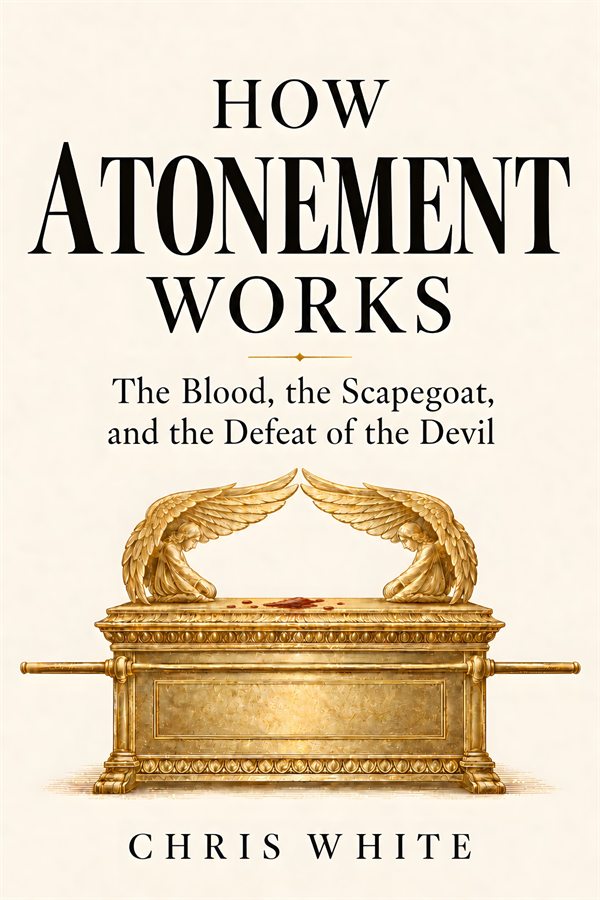
The book follows the sins all the way. How Atonement Works traces the live goat from Leviticus 16 through the sin-bearer of Isaiah 53, the descent to the dead, and what the return of the sins did to the devil’s power of death.
Get the Paperback on AmazonHow Other Christians Read These Texts
Many careful readers take the goat’s journey as a means of removal. On this view the sins had to leave the camp, away from the people and from God’s house, and the wilderness was the natural place to send them because no one lived there. Milgrom and David Wright, who studied similar rites among Israel’s neighbors, read the goat as a vehicle for carrying sins away, and on their account the being in the wilderness has no part in why the rite works. Christians who read Psalm 103:12 and Micah 7:19 the same way hear in them that forgiven sins are gone for good and that God does not hold them against his people. Chris White agrees that the sins had to leave the camp. He differs over the named destination.
On the descent, many Protestants follow John Calvin. Calvin read “he descended into hell” as the anguish Christ suffered in his soul on the cross and in Gethsemane, and he denied that Christ’s soul went down to the place of the dead. The Heidelberg Catechism taught the same. The book answers that Peter, Paul, and Jesus himself place the descent after the death and before the resurrection, which is the order of the creed. It shares Calvin’s concern that nothing be taken from the cross. The sins were borne on the cross, and the descent was no further suffering.
What the Return Means for Forgiveness
The sins Christ carried were ours. Bearing them did not make him a sinner. John writes, “he was manifested to take away our sins; and in him is no sin” (1 John 3:5). The live goat had done nothing wrong, and it carried what the people had done.
What the return accomplished for us is what the Day of Atonement accomplished for Israel: “that ye may be clean from all your sins before the LORD” (Leviticus 16:30). The sins are gone from the people because they were carried away and left where they belong. That is forgiveness. Paul says that God has quickened us together with Christ, “having forgiven you all trespasses” (Colossians 2:13).
The book goes on to ask what the return did to Azazel. Hebrews says that Christ took part in flesh and blood “that through death he might destroy him that had the power of death, that is, the devil” (Hebrews 2:14). Chris White argues that the devil’s power of death rested on sin and on the true accusation sin supports. When the sins were carried away and forgiven, the accuser had nothing left to bring against those who are in Christ.
Christ did not stay among the dead. God raised him up, “because it was not possible that he should be holden of it” (Acts 2:24). Death could not keep the one who had no sin of his own, and he came out holding its keys.
Where This Understanding Comes From
Much of this account rests on earlier work. Jacob Milgrom’s commentary on Leviticus read Azazel as a personal name and described the rite as returning evil to its source. Christophe Nihan, Baruch Schwartz, and Gary Anderson wrote on how Leviticus treats sin as a burden that can be carried away. Michael Heiser connected the wilderness of Azazel with the realm of the dead. Emma Ford and Richard Barry have studied the scapegoat in Isaiah 53. David M. Moffitt noted how Hebrews 13 draws on the burning outside the camp in Leviticus 16:27. Richard Bauckham and Samuel Renihan have written on Christ’s descent to the dead, and Renihan connects the descent with the goat sent to Azazel. Among early Christian writers, the Epistle of Barnabas and Justin Martyr saw Christ in the second goat, and Ignatius, Irenaeus, and Origen taught that Christ went down to the dead. How Atonement Works builds on this work and credits it.