The short answer
In the Old Testament, to bear sin is to carry it as a weight. A sinner who carries his own sin suffers for it. When another carries it for him, it is lifted off him. Isaiah 53, 1 Peter 2:24 and Hebrews 9:28 describe Christ bearing our sins in the words Leviticus uses of the live goat, the one animal that had sins confessed over it. Our sins were really laid on him, he remained without sin, and he carried them away so that we could be forgiven.
What the New Testament Says
Several New Testament writers say that Christ bore our sins. Peter first quotes Isaiah’s words about the servant’s innocence, “Who did no sin, neither was guile found in his mouth” (1 Peter 2:22), and then writes:
Who his own self bare our sins in his own body on the tree, that we, being dead to sins, should live unto righteousness: by whose stripes ye were healed.
1 Peter 2:24
Hebrews says that Christ “was once offered to bear the sins of many,” and that he will “appear the second time without sin unto salvation” (Hebrews 9:28). John the Baptist pointed to Jesus as “the Lamb of God, which taketh away the sin of the world” (John 1:29).
Peter and Hebrews both take their wording from Isaiah 53. Peter’s Greek verb for “bare” is the one the Greek Old Testament used in Isaiah 53:12, “he bare the sin of many,” and Hebrews uses the same verb with the same object, “the sins of many.” So the meaning of the apostles’ words runs back through Isaiah to the law that Isaiah knew.
What “Bearing” Sin Meant in Leviticus
The Old Testament usually speaks of sin as a weight. The psalmist says, “For mine iniquities are gone over mine head: as an heavy burden they are too heavy for me” (Psalm 38:4). Isaiah calls Israel “a people laden with iniquity” (Isaiah 1:4). The Hebrew expression for this is nasa’ ‘avon, to carry iniquity, and it is the Hebrew Bible’s most common way of describing sin.
Its meaning depends on who carries the load. Most often the sinner carries his own. A witness who keeps silent “shall bear his iniquity” (Leviticus 5:1). For him, bearing sin means being answerable for it and suffering what follows from it.
The same words are used when someone carries iniquity that belongs to others, and then they mean something else. Aaron wore the gold plate on his forehead so that he “may bear the iniquity of the holy things” the people offered (Exodus 28:38). The priests ate the sin offering “to bear the iniquity of the congregation, to make atonement for them” (Leviticus 10:17). Ezekiel lay on his side to “bear the iniquity of the house of Israel” (Ezekiel 4:5). None of these men was punished for what he carried. Each bore, as part of his office or as a sign, a burden that was lifted off others.
The same expression describes God’s forgiveness. The LORD called himself the God “forgiving iniquity and transgression and sin” (Exodus 34:7), and Micah asks, “Who is a God like unto thee, that pardoneth iniquity” (Micah 7:18). In both verses the Hebrew behind “forgiving” and “pardoneth” is the expression for carrying iniquity. When a man carries his own sin, he suffers for it. When God carries it, the man is free of it.
One Hand on the Offerings, Two Hands on the Live Goat
Many Christians picture every Old Testament sacrifice as an animal that received the worshiper’s sins and died for them. Leviticus describes something narrower. In the ordinary offerings the worshiper laid one hand on the animal before it was killed, and the law describes no sin passing to it. Jacob Milgrom and David P. Wright, two leading scholars of Leviticus, read that one-handed gesture as the worshiper’s declaration that the animal was his to give.
The Day of Atonement has a different rite. After the sanctuary had been cleansed with blood, the high priest turned to the second goat:
And Aaron shall lay both his hands upon the head of the live goat, and confess over him all the iniquities of the children of Israel, and all their transgressions in all their sins, putting them upon the head of the goat, and shall send him away by the hand of a fit man into the wilderness: And the goat shall bear upon him all their iniquities unto a land not inhabited: and he shall let go the goat in the wilderness.
Leviticus 16:21–22
Here the high priest uses both hands and confesses the sins out loud. The text says he puts them on the goat’s head, and the goat bears them. This is the one animal in the law that has sins confessed over it and placed on it, and it was kept alive. It is also the one place where the law applies the expression “bear iniquity” to an animal. The book’s account of this goat and its fulfillment in Christ is summarized on the page Was Jesus the scapegoat?
Isaiah 53: The Servant Who Bore Our Iniquities
Isaiah’s poem describes a servant of the LORD who is despised, who suffers and dies, and whose suffering turns out to have been for the people who despised him. Philip explained it to the Ethiopian as a passage about Jesus (Acts 8:32–35), and Jesus applied a line of it to himself on the night he was arrested (Luke 22:37). Its central verses say:
Surely he hath borne our griefs, and carried our sorrows: yet we did esteem him stricken, smitten of God, and afflicted. But he was wounded for our transgressions, he was bruised for our iniquities: the chastisement of our peace was upon him; and with his stripes we are healed. All we like sheep have gone astray; we have turned every one to his own way; and the LORD hath laid on him the iniquity of us all.
Isaiah 53:4–6
The poem closes on the same theme. The servant “shall bear their iniquities” (53:11), and “he bare the sin of many, and made intercession for the transgressors” (53:12).
These verses use the language of the live goat. In Leviticus 16:21 the high priest puts “all the iniquities of the children of Israel” on the goat’s head; in Isaiah 53:6 “the LORD hath laid on him the iniquity of us all.” The goat “shall bear upon him all their iniquities,” and the servant “shall bear their iniquities.” In Hebrew, the verb in “he bare the sin of many” is the verb used of the goat. The goat goes to “a land not inhabited,” which in Hebrew is a land cut off, and the servant “was cut off out of the land of the living” (53:8). The two phrases share a root and the same word for land.
Isaiah draws on more than one part of Israel’s worship. He calls the servant’s soul “an offering for sin” (53:10) and compares him to “a lamb to the slaughter” (53:7). Scholars differ over how much of the poem alludes to Leviticus 16. Emma Ford has argued that Isaiah presents the servant as a scapegoat, while others see the wider sacrificial system as the background. Either way, the law’s only earlier picture of iniquity laid on one who then bears it is the goat on which Aaron laid both hands. Chris White argues that this is the picture behind Peter’s and Hebrews’ words.
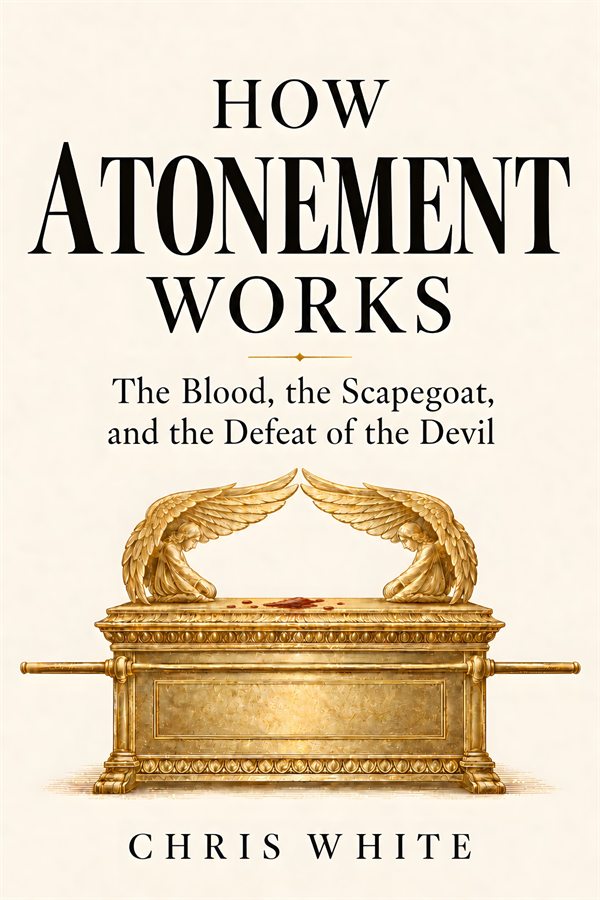
Christ bore our sins as one part of a larger work. How Atonement Works follows the whole Day of Atonement into the work of Christ: the blood brought before God, the sins carried away, and the defeat of the devil.
Get the Paperback on AmazonBearing Our Sins Did Not Make Christ a Sinner
The sins Christ bore were really ours, and they were really on him. Isaiah says the LORD laid them on him. Peter says he bore them “in his own body.” Every writer who says this also says that Christ had no sin of his own. Isaiah says “he had done no violence, neither was any deceit in his mouth” (53:9). Peter says he “did no sin” (1 Peter 2:22). Hebrews calls him “holy, harmless, undefiled, separate from sinners” (7:26), a high priest “in all points tempted like as we are, yet without sin” (4:15). John puts both truths in one verse:
And ye know that he was manifested to take away our sins; and in him is no sin.
1 John 3:5
The live goat shows how both can be true. The goat had done nothing wrong, and it carried what the people had done. Christ carried a burden that belonged to us, and he remained holy while he carried it. Richard Barry observes that Peter describes sin as the priestly writings do, as a weight that can be carried, and that because the one carrying it is sinless, sin appears in 1 Peter 2:24 as something that can be transferred. Bearing sin describes the load Christ took up for others. His own character was never stained by it.
What Paul Meant by “Made Him to Be Sin”
For he hath made him to be sin for us, who knew no sin; that we might be made the righteousness of God in him.
2 Corinthians 5:21
This is the New Testament’s most compressed statement of what happened to Christ, and Christians have read it in several ways. Chris White reads it in the light of the live goat. On the Day of Atonement Israel’s sins were placed on the goat so completely that it had to be sent out of the camp, and the man who led it away had to wash before he came back (Leviticus 16:26). For that day the goat was the carrier of Israel’s sin. The book takes Paul to mean that God made Christ, who “knew no sin,” the one on whom our sin lay, so that he carried it as the goat did. Paul does not name the goat in this verse, so the connection is the book’s reading.
Other readings are well established. Many interpreters, N. T. Wright among them, take “sin” here to mean “sin offering” and compare Romans 8:3. Teachers of penal substitution read the first half as God treating Christ as a sinner and punishing him in our place, and the second half as believers credited with Christ’s own righteousness. In the appendix to the book, Chris White grants that the wording of the verse alone settles neither the scapegoat allusion nor the question of penal substitution. What it states plainly is that the sinless Christ was identified with our sin, on our behalf, so that we might be reconciled to God.
The appendix also raises a question about the word “we.” In the verses just before, Paul describes the ministry of reconciliation given to him and his co-workers, who are “ambassadors for Christ” (5:20). Following Wright, the appendix suggests that “we might be made the righteousness of God in him” refers first to Paul and his fellow workers, who embody God’s reconciling faithfulness in their ministry. Applying the verse to every believer’s standing is a further step. Many readers take that step, and the book’s conclusion applies the phrase to all believers through their union with Christ: they share what is Christ’s because they are in him.
How Penal Substitution Reads These Verses
The explanation of the cross most often preached today is penal substitution. It holds that God’s justice requires sin to be punished, and that when Christ bore our sins he bore their penalty. God’s wrath against our sin fell on him at the cross, and because of that God forgives those who believe. Its teachers point to Isaiah’s words, “the chastisement of our peace was upon him” (53:5). On this view, to bear sin is to bear its punishment.
Chris White shares a great deal with this view. He agrees that Christ died for us and in our place, that he bore our sins, that sin is serious and brings death, and that God provided the atonement out of love. He differs over what bearing meant. In Leviticus, carrying another’s iniquity and being punished for it are different things. The priests and Ezekiel bore iniquity and were not punished, and the one animal the law says bore the people’s iniquities was the one animal of the day that was kept alive. The goat that died, whose blood was brought before God, had no sins confessed over it. The book makes its full case in its chapter on penal substitution.
Why He Bore Them: Our Forgiveness
Scripture joins Christ’s bearing of our sins to our forgiveness. Isaiah says “with his stripes we are healed” (53:5) and that the servant shall “justify many; for he shall bear their iniquities” (53:11). Peter says Christ bore them “that we, being dead to sins, should live unto righteousness.” Paul writes that God “hath quickened” us together with Christ, “having forgiven you all trespasses” (Colossians 2:13). Leviticus states what Israel received on the Day of Atonement:
For on that day shall the priest make an atonement for you, to cleanse you, that ye may be clean from all your sins before the LORD.
Leviticus 16:30
The transfer ran one way. Sins went from the people to the goat, and nothing went from the goat to the people. They received cleansing, forgiveness, and God’s presence remaining among them. They did not receive the goat’s innocence as a credit, because the goat had done nothing. Chris White applies the same pattern to Christ: our sins went onto him, and we are forgiven. He holds that the righteousness believers have comes to them through union with Christ, the subject of the book’s appendix.
At the Last Supper Jesus said his blood was “shed for many for the remission of sins” (Matthew 26:28). The Greek word for remission, aphesis, is the word the Greek translators of Leviticus used when they called the goat “set apart for release.” The other side of that work, Christ’s blood brought before God by the risen high priest, is explained on the page on why the resurrection is needed for forgiveness.
Where This Understanding Comes From
Reading Isaiah 53 as a portrait of Christ the sin-bearer begins in the New Testament itself. The book’s account of what it means to bear sin draws on Baruch Schwartz and Gary Anderson, who traced the Hebrew Bible’s picture of sin as a weight, on Jacob Milgrom’s commentary on Leviticus, on David P. Wright’s study of the laying on of hands, and on Andrei Orlov’s study of the two goats in early Jewish writings. For Isaiah 53 it draws on Emma Ford, who argues that the servant is portrayed as a scapegoat, on Joseph Blenkinsopp and KyeSang Ha on the poem’s sacrificial language, and on Richard Barry’s study of the two goats and the cross.
The appendix on 2 Corinthians 5:21 engages Morna Hooker’s work on interchange in Paul, N. T. Wright’s reading of “the righteousness of God,” and the second-century bishop Irenaeus, who wrote of the Son becoming what we are so that we might become what he is. How Atonement Works builds on this scholarship and credits it.