The short answer
“Propitiation” in Romans 3:25 translates the Greek hilastērion. In the Greek Old Testament that Paul read, the word names the mercy seat, the gold lid of the Ark, where God met Moses and where the high priest sprinkled the blood on the Day of Atonement. Many teachers read it as the satisfying of God’s wrath, and others translate it “expiation.” Chris White reads it, with a number of scholars, as the mercy seat: Christ is the place where atonement is made and where God meets his people.
What Paul Wrote in Romans 3:25
Romans 3 closes Paul’s long argument that Jews and Gentiles alike have sinned and fall short of God’s glory (Romans 3:23). Then he turns to what God has done about it. Believers are justified freely by his grace, through the redemption that is in Christ Jesus (3:24), and in the next verse Paul says how:
Whom God hath set forth to be a propitiation through faith in his blood, to declare his righteousness for the remission of sins that are past, through the forbearance of God.
Romans 3:25
“Propitiation” translates the Greek word hilastērion. The King James Version uses “propitiation” here, and in Hebrews 9:5 it translates the same word “mercyseat”: “the cherubims of glory shadowing the mercyseat.”
Modern translations divide over Romans 3:25. The KJV, the NASB 1995, and the ESV have “propitiation.” The RSV has “expiation.” The NIV and NRSV have “sacrifice of atonement.” The Christian Standard Bible and the NET have “mercy seat,” as William Tyndale did in 1534 with “a seate of mercy.” The differences go back to the object the word first named.
The Mercy Seat: The Lid of the Ark
When God gave Moses the pattern of the tabernacle, the first thing he described was the Ark, a chest of wood overlaid with gold, holding the tables of the law. Its lid was a slab of pure gold with two cherubim of beaten gold at its ends, their wings spread over it and their faces turned toward it (Exodus 25:10–21). Then God said what the lid was for:
And there I will meet with thee, and I will commune with thee from above the mercy seat, from between the two cherubims which are upon the ark of the testimony.
Exodus 25:22
The lid stood behind the veil in the most holy place, and of that room God said, “I will appear in the cloud upon the mercy seat” (Leviticus 16:2). Scripture also pictures it as the place of God’s throne. “The LORD reigneth; let the people tremble: he sitteth between the cherubims” (Psalm 99:1). The place where God sat enthroned, the place where he spoke, and the place where the blood was put on the Day of Atonement were one place.
What Was Done on the Lid
The Hebrew name of the lid is kapporet. It shares its root with kipper, the verb the law uses for making atonement, and with the name of the day, yom hakkippurim. On the Day of Atonement the high priest carried the blood of the bull and the goat through the veil and sprinkled it on the lid and before it.
Leviticus says what that blood did. The high priest made “an atonement for the holy place, because of the uncleanness of the children of Israel” (Leviticus 16:16), and the day was given “to cleanse you, that ye may be clean from all your sins before the LORD” (Leviticus 16:30). The people’s uncleanness and sins had defiled God’s house. The blood on the lid cleansed it, so that God could go on dwelling among them.
Scholars disagree about the root meaning of kipper. Some have taken it to mean “to cover,” which lies behind a common teaching that the old sacrifices only covered sins until Christ came. Jacob Milgrom traced it to a word for wiping something clean, and Jay Sklar connects it with kofer, “ransom.” Whatever its origin, its use on the Day of Atonement is plain: the lid was where God’s house was cleansed with blood. The English name “mercy seat” seems to come through Tyndale from Luther’s German Gnadenstuhl, and some modern translations call the lid the “atonement cover.” One name says what God showed there, and the other says what was done there.
How Paul’s Greek Bible Used the Word
The Septuagint, the Greek translation of the Old Testament made by Jewish scholars before Christ, was the Bible most of the New Testament writers quoted. It calls the lid hilastērion twenty-one times in Exodus, Leviticus, and Numbers. At its first appearance it calls the lid “a hilastērion, a lid” (Exodus 25:17). In the Greek Old Testament the word always names a thing or a place, and where blood is involved, it is the place the blood is put.
Outside the Bible, the family of words that hilastērion belongs to was used for appeasing the gods, and a hilastērion could be an offering, such as a statue or monument, set up to win a god’s favor. So the Greek word carried a possible meaning, the appeasing of an angry god, that the Hebrew kapporet did not have.
The Jewish translators used the whole family of words for the Hebrew vocabulary of atonement, with the objects the Hebrew gives: the holy place, the tent, the altar, and the people. When God is the subject, the verb means to forgive. It stands behind “pardon mine iniquity” (Psalm 25:11), and the related noun translates “there is forgiveness with thee” (Psalm 130:4). The older sense did not vanish entirely. Even the Hebrew verb could be used for calming a person’s anger, as when Jacob said of Esau, “I will appease him with the present that goeth before me” (Genesis 32:20). But in the Hebrew Bible, kipper is done to places and to sins, and it is done for people. God is never the one it is done to.
The Case for Reading It as Propitiation
The word “propitiation” came into the English Bible from the Latin Vulgate. Tyndale had “a seate of mercy,” and the Geneva Bible of 1560 had “a reconciliation.” The Bishops’ Bible of 1568 followed the Latin propitiationem with “a propitiation,” and the King James translators, who were revising the Bishops’ Bible, kept it. In much Reformed and evangelical teaching, Romans 3:25 is a central text for penal substitution, and “propitiation” there means that God’s wrath against sin was satisfied when Christ was punished in our place.
That reading has serious support beyond the English word. In the twentieth century C. H. Dodd argued that the Septuagint had turned these words toward “expiation,” the removal of sin. Leon Morris, the best-known defender of propitiation, answered that in ordinary Greek these words were used for appeasing the gods and that the Greek Bible did not empty them of that sense. The Old Testament itself sometimes joins atonement to the turning away of wrath. After Korah’s rebellion, God’s wrath broke out against the murmuring congregation:
And Moses said unto Aaron, Take a censer, and put fire therein from off the altar, and put on incense, and go quickly unto the congregation, and make an atonement for them: for there is wrath gone out from the LORD; the plague is begun.
Numbers 16:46
Later God said that Phinehas “hath turned my wrath away from the children of Israel” and “made an atonement for the children of Israel” (Numbers 25:11, 13). Romans 3:25 also stands in a letter that opens with “the wrath of God is revealed from heaven” (Romans 1:18) and promises that believers “shall be saved from wrath through him” (Romans 5:9). A Jewish writing from near the time of the New Testament, 4 Maccabees, uses hilastērion for the deaths of the Jewish martyrs, which it presents as preserving Israel. Defenders of propitiation weigh all of this, and they are right that wrath belongs in the context of Romans.
Propitiation, Expiation, or Mercy Seat?
The case for “expiation” rests on the evidence of the Greek Bible. There these words speak of cleansing holy places, removing sins, and God forgiving, and God is never the one atonement is made to. That is why the RSV chose “expiation,” and many scholars still prefer it.
Chris White affirms that God’s wrath against sin is real and that Christ saves his people from it (Romans 1:18; 5:9; 1 Thessalonians 1:10). He agrees that atonement deals with what provokes God’s wrath. The translators of the Christian Standard Bible, whose oversight committee included Thomas Schreiner, a well-known defender of penal substitution, chose “mercy seat” for Romans 3:25 and explained that the idea of propitiation is not lost by that choice.
The book’s point is narrower. The word hilastērion by itself does not tell us that God’s wrath was satisfied by punishing Christ in our place. Even in Numbers 16 and 25, Aaron makes atonement “for the people,” and the plague stops because the cause of the wrath has been dealt with. Neither passage has the wrath falling on a substitute. As for 4 Maccabees, it is outside the canon, it does not use the word for the lid, and it has to be weighed against the way Paul’s own Bible used the word. Whether God’s wrath was poured out on Christ is a separate question, which the book takes up in its chapter on penal substitution.
Chris White writes, “I do not think ‘propitiation’ is the best translation of hilastērion.” In his view the English word brings forward one possible sense of the Greek, and as it is usually taught it leaves out the cleansing the Hebrew word was about. “Mercy seat” or “place of atonement” keeps that meaning and reads the word the way Paul’s Bible used it, for the lid. The lid was where blood cleansed what the people’s sins had defiled, so that God could go on dwelling among them and forgive them.
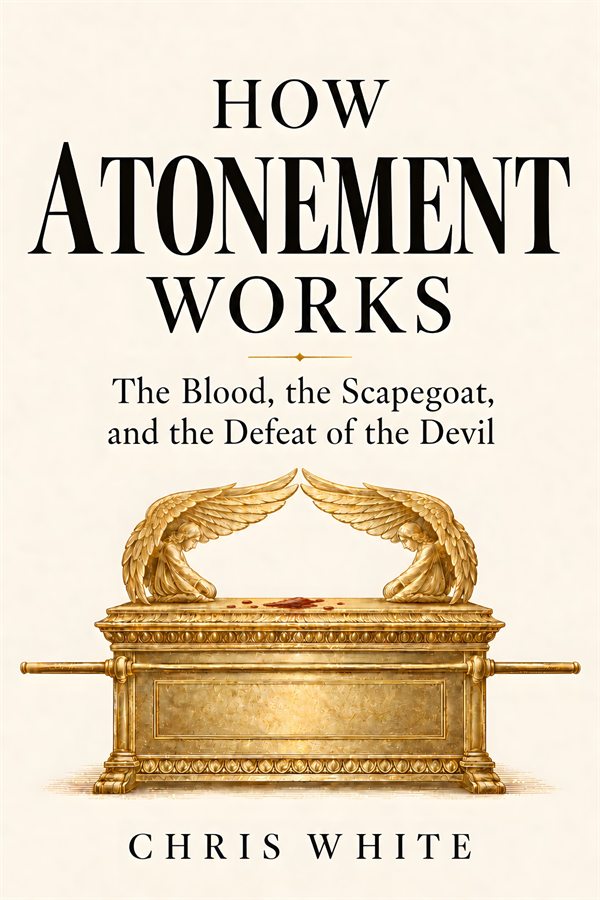
The mercy seat is one step in a larger account. How Atonement Works traces the whole Day of Atonement through the work of Christ: the blood, the high priest in heaven, the scapegoat that carried sins away, and the defeat of the devil.
Get the Paperback on AmazonChrist: The Blood, the Priest, and the Place
Daniel Bailey, who studied the known uses of hilastērion for his doctoral dissertation at Cambridge, found none in which it names an animal that was killed. He argued that Paul presents Jesus as the new mercy seat, the place where God makes himself known and where atonement is made. How Atonement Works follows this reading. Paul’s phrase “through faith in his blood” fits it well: on the Day of Atonement the blood was brought to the lid.
The book then draws out what that means. In the old covenant the blood, the high priest who carried it, and the lid it was put on were three different things. In the new covenant Christ is all three. The blood is his own. He is the high priest who brings it before God, since “by his own blood he entered in once into the holy place” (Hebrews 9:12). And he is the place where it is applied, the one God “hath set forth” as the hilastērion.
Hebrews follows the high priest into the holy place and then follows Christ, who entered “into heaven itself, now to appear in the presence of God for us” (Hebrews 9:24). On the Day of Atonement the blood was brought to the lid and God’s house was cleansed. Christ’s work as high priest in the heavenly sanctuary after his resurrection is the subject of a companion article, on the resurrection and forgiveness.
From the Mercy Seat to the Throne of Grace
The lid was the place where God met his people, yet the people never reached it. On one day of the year one man went behind the veil, under the warning “that he die not” (Leviticus 16:2), and came out again. Israel was made clean so that God could stay in the camp.
The New Testament describes something closer. Paul says that “we have peace with God through our Lord Jesus Christ: By whom also we have access by faith into this grace wherein we stand” (Romans 5:1–2). Hebrews says that believers now have “boldness to enter into the holiest by the blood of Jesus” (Hebrews 10:19), and it tells them, “Let us therefore come boldly unto the throne of grace, that we may obtain mercy” (Hebrews 4:16). Several biblical and later Jewish texts link God’s throne with the mercy seat. The throne of grace where Christ sat down is the true counterpart of the lid of the Ark, and the people who once stood outside now come to the place of atonement themselves.
John uses a related word, hilasmos, in the same setting. In the Greek Old Testament it named the Day of Atonement and translated the word for forgiveness. John writes that “the blood of Jesus Christ his Son cleanseth us from all sin,” and then:
And if any man sin, we have an advocate with the Father, Jesus Christ the righteous: And he is the propitiation for our sins: and not for ours only, but also for the sins of the whole world.
1 John 2:1–2
The atonement is God’s own provision. Leviticus said that God gave the blood “upon the altar to make an atonement for your souls” (Leviticus 17:11), and John says, “Herein is love, not that we loved God, but that he loved us, and sent his Son to be the propitiation for our sins” (1 John 4:10). Believers come to that throne day by day, confess their sins, and are forgiven, because Christ, who is himself the atonement, is already in the Father’s presence.
Where This Understanding Comes From
Reading Romans 3:25 as a reference to the mercy seat is an interpretation with a long history and serious scholarly support. Tyndale translated it that way in 1534. In modern scholarship Daniel P. Bailey’s Cambridge dissertation made the case at length, and the Christian Standard Bible and NET translate the verse “mercy seat.” The debate over propitiation and expiation runs through C. H. Dodd and Leon Morris. Jacob Milgrom’s study of Leviticus showed how the blood of the purification offering cleansed God’s house, and Jay Sklar’s work connects atonement with ransom. David M. Moffitt’s Rethinking the Atonement (2022) links the mercy seat with God’s throne and places the heart of the Day of Atonement at the bringing of the blood into God’s presence. How Atonement Works builds on this scholarship and credits it.