The short answer
What was nailed to the cross was a written record that stood against us, which the King James Version calls “the handwriting of ordinances.” The Greek word, cheirographon, was the usual word for a signed note of debt. Some read it as the law of Moses, some as our debt to God, and some as a record of our sins. On every reading it was a true record of guilt, and Paul says God blotted it out by forgiving all our trespasses.
What Colossians 2:14 Says
Paul wrote to a church that was being told it needed something more than Christ: special observances, angelic mediators, and rules about food and days. His answer was that in Christ they already had everything. They had been circumcised “with the circumcision made without hands,” buried with Christ in baptism, and raised with him (Colossians 2:11–12). Then he described how they came to be alive:
And you, being dead in your sins and the uncircumcision of your flesh, hath he quickened together with him, having forgiven you all trespasses; blotting out the handwriting of ordinances that was against us, which was contrary to us, and took it out of the way, nailing it to his cross.
Colossians 2:13–14
Verse 14 continues the sentence of verse 13. Paul begins with forgiveness, “having forgiven you all trespasses,” and then describes what that forgiveness did to a written document. God blotted it out, took it out of the way, and nailed it to the cross. Paul calls the document hostile twice: it was “against us,” and it was “contrary to us.”
The verb translated “forgiven” is built on the Greek word for grace. It means to give freely, as a favor. Luke uses it of the creditor in Jesus’ parable who had two debtors: “And when they had nothing to pay, he frankly forgave them both” (Luke 7:42). Paul uses it again when he tells the Colossians to forgive one another “even as Christ forgave you” (Colossians 3:13). The forgiveness of verse 13 is a gift to people who had nothing to pay, and verse 14 describes that gift as the cancelling of a written record.
“Blotting Out”: The Old Testament Word for Forgiving
The Greek verb behind “blotting out” means to wipe away. It is the word the Greek translators of the Old Testament used for God’s own forgiving:
I, even I, am he that blotteth out thy transgressions for mine own sake, and will not remember thy sins.
Isaiah 43:25
David prays with the same word in Psalm 51, “blot out my transgressions” and “blot out all mine iniquities” (Psalm 51:1, 9). It is also the word for erasing a name from God’s book (Exodus 32:32–33; Psalm 69:28), and Peter uses it when he calls his hearers to repent “that your sins may be blotted out” (Acts 3:19).
As How Atonement Works puts it, “To blot out a record is to make it as if it had never been written.” When Paul says that God blotted out the handwriting, he is describing forgiveness in the words Israel had long used for it. Verse 14 gives verse 13 a picture.
What Is the “Handwriting of Ordinances”?
“Handwriting” translates the Greek cheirographon, which means a handwritten document. The word appears only here in the New Testament. In the business papyri of Paul’s world it was the usual word for a note of debt: a document written out and signed by the debtor as an acknowledgment of what he owed. The New American Standard Bible renders it “certificate of debt,” and the English Standard Version “record of debt.”
Paul describes the document in three ways. It was “of ordinances,” meaning it consisted in decrees or legal demands. It was “against us.” And it was “contrary to us.” Whatever its exact form, it stood on the opposing side of the case.
He also says three things were done to it. It was blotted out. It was taken “out of the way,” removed altogether. And it was nailed to the cross.
Three Ways Christians Have Read It
Readers have taken the handwriting in three main ways, and each has real support.
The law of Moses
Many readers, ancient and modern, take the handwriting to be the law itself. Paul uses the same word for “ordinances” in Ephesians, where he says Christ abolished in his flesh “the law of commandments contained in ordinances” (Ephesians 2:15). The setting in Colossians fits this reading, since the teachers troubling the church were pressing rules about food and holy days. John Calvin took the ordinances to be the ceremonies of the law, which he regarded as written bonds that kept Israel obligated. On this reading, what was nailed to the cross was the law’s claim against those who had not kept it.
Our signed note of debt
Others follow the papyri. A cheirographon was a debtor’s own signed acknowledgment, so the handwriting is the obligation our sins placed us under, an IOU in our own hand. This reading fits the language of debt that Jesus used for sin, as in the prayer “forgive us our debts” (Matthew 6:12) and the parable of the two debtors.
A record of charges
Others take it to be a written indictment, a list of our sins kept against us. A Jewish apocalypse of uncertain date, the Apocalypse of Zephaniah, describes a written account of a man’s sins, and its surviving text uses this same word for it. On this reading the handwriting is the case against us.
What the Readings Agree On
The three readings disagree about the kind of document. They agree about what it did and what happened to it.
- It was a true record. On the law reading, we had not met the law’s demands. On the debt reading, we owed what we had signed for. On the charge reading, we had done what was written. In each case the document stood against us because it was accurate.
- It was a record before God. Paul says that God forgave and that God blotted the record out, so the debt or the charge was owed to God.
- Its removal was forgiveness. Paul describes the record as blotted out, and he names that act in the words “having forgiven you all trespasses.”
Many Christians understand the cross as Christ paying our debt in full, and they read verse 14 that way: the note was nailed up because it had been settled. The words Paul chose in verses 13 and 14, “forgiven” and “blotting out,” are both words for cancelling. The book draws the line plainly: “A record that has been blotted out has not been paid off.” A creditor who forgives a note tears it up. Jesus’ parable of the two debtors uses the same picture.
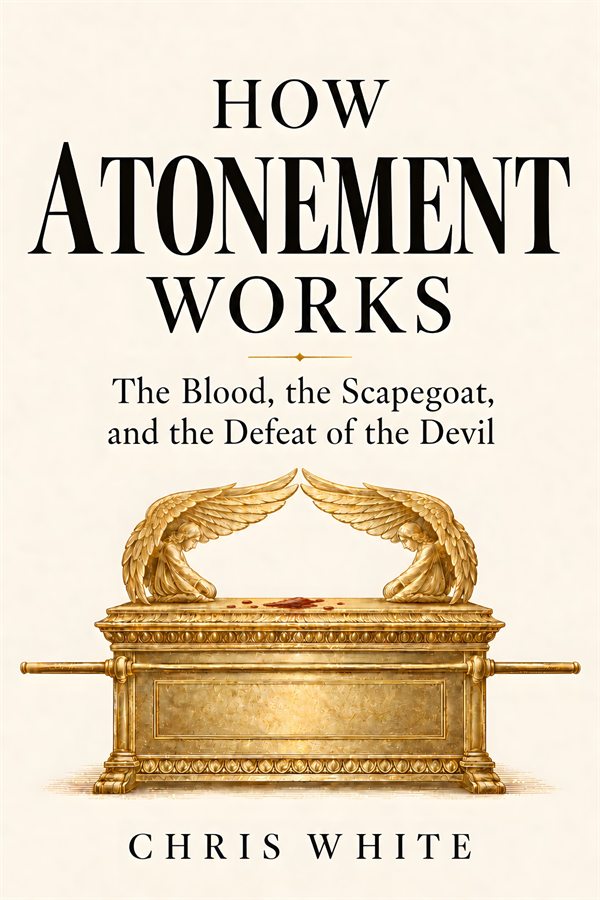
Colossians 2:14 is one step in a larger account. How Atonement Works traces the whole Day of Atonement through the work of Christ: the blood, the high priest in heaven, the scapegoat that carried sins away, and the defeat of the devil.
Get the Paperback on AmazonThe Book’s Reading: The Record of Charges
Chris White takes the third reading. He reads the handwriting as the record of our sins, the charge sheet against us. His reason comes from the way Scripture describes the devil. Zechariah saw Joshua the high priest standing in filthy garments before the angel of the LORD, “and Satan standing at his right hand to resist him” (Zechariah 3:1). Revelation calls the devil “the accuser of our brethren . . . which accused them before our God day and night” (Revelation 12:10). An accusation rests on a record of what the accused person did.
The book argues that the devil’s power of death rested on sin: on the true charge he could bring against every accountable person, and on the sentence of death that follows a true charge. Colossians joins three things in one sentence: forgiveness, the cancelling of a hostile record, and the stripping of the principalities and powers. Chris White reads that sequence as the removal of the charge that gave the powers their hold.
This is an interpretation, and the book presents it as one. Paul does not say that the devil wrote the record or owned it. The record was a record of debt to God, and God is the one who forgave it. The idea that the accuser used this record against us comes from what other passages say about him, and the book holds it as a step beyond the text of Colossians. A reader who prefers the law reading or the debt reading still has what Paul plainly says: the record of our guilt was blotted out in forgiveness and nailed to the cross.
Why Paul Says It Was Nailed to the Cross
Paul places the cancellation at the cross. Peter says that Christ “his own self bare our sins in his own body on the tree” (1 Peter 2:24), and Isaiah had said that “the LORD hath laid on him the iniquity of us all” (Isaiah 53:6). If the sins were carried to the cross, the record of them was dealt with there. Paul’s picture fastens the written case against us to the same cross on which Christ bore the sins it described.
The book also reads the verse alongside the Day of Atonement. On that day the high priest confessed Israel’s sins over the live goat, and the goat carried them away into the wilderness (Leviticus 16:21–22), so that the people were clean from all their sins before the LORD (Leviticus 16:30). Chris White reads Christ as fulfilling that goat: the sins were laid on him and carried away, and the record of them was blotted out. Origen made a similar connection in the third century, reading Colossians 2:14–15 together with the scapegoat in his sermon on Leviticus 16.
The devil received nothing. The book holds that nothing was paid to him and no bargain was made with him. God cancelled the record because the debt was owed to God.
From Verse 14 to Verse 15
Paul’s sentence goes on: “and having spoiled principalities and powers, he made a shew of them openly, triumphing over them in it” (Colossians 2:15). With the record gone, the powers were stripped and led in triumph, as a Roman general led his captives through the city. Earlier in the letter Paul had already joined deliverance from a hostile power with forgiveness. The Father “hath delivered us from the power of darkness, and hath translated us into the kingdom of his dear Son: in whom we have redemption through his blood, even the forgiveness of sins” (Colossians 1:13–14).
How the cancelling of the record disarmed the powers is the subject of a companion article, How Does Forgiveness Defeat Satan?, which follows verse 15 and the accuser in detail. The wider question of how Christ’s death broke the devil’s power is taken up in How Did Jesus Defeat the Devil? Verse 14 supplies the first step in both: the written case against us was cancelled by forgiveness, at the cross.
Where This Understanding Comes From
The meaning of cheirographon in the papyri has been studied closely, including by Kyu Seop Kim in an article in the Tyndale Bulletin. For the range of interpretations of the verse, the book draws on Peter T. O’Brien’s commentary on Colossians in the Word Biblical Commentary and on Roy Yates’s study of the verse as a metaphor of forgiveness. John Calvin’s commentary on Colossians represents the law reading, and Calvin also identified the principalities and powers of verse 15 as devils who could no longer bring anything against believers. Origen, in his homilies on Leviticus, connected these verses with the scapegoat. How Atonement Works builds on these readers and credits them. Its reading of the handwriting as the accuser’s case is one interpretation among several that faithful Christians hold.