The short answer
Yes, in the sense the New Testament describes. On the Day of Atonement two goats made one atonement. The first was killed and its blood was carried into the holy of holies. The second, the scapegoat, had Israel’s sins confessed over it and carried them away alive. Isaiah 53, 1 Peter 2:24 and Hebrews 9:28 describe Christ bearing our sins in the words used of that goat. Chris White argues that Christ fulfilled both goats, as early Christian writers such as Justin Martyr also taught.
Two Goats, One Atonement
Leviticus 16 sets out the Day of Atonement, the one day each year when Israel’s high priest went behind the veil into the holy of holies. Two goats were taken from the people “for a sin offering” (Leviticus 16:5). Both were presented before the LORD, and the high priest cast lots over them: “one lot for the LORD, and the other lot for the scapegoat” (Leviticus 16:8). Where the King James Version has “scapegoat,” the Hebrew has the name Azazel.
The goat for the LORD was killed. Aaron carried its blood through the veil and sprinkled it on the lid of the Ark and before it, then on the altar. With that blood he made “an atonement for the holy place, because of the uncleanness of the children of Israel” (Leviticus 16:16). The blood went in, toward God, and cleansed his house.
The second goat had been standing alive at the door of the tabernacle through all of this. Leviticus says it was “presented alive before the LORD, to make an atonement with him” (Leviticus 16:10). So the day’s atonement was not complete until the live goat had done its part. The book calls this two movements, one toward God and one away from him, which together made the atonement of that day.
Most Christians know the first half of this pattern from Hebrews, which says Christ entered the holy place “by his own blood” (Hebrews 9:12). The question on this page is about the second half.
What the Live Goat Did
After the sanctuary had been cleansed, Aaron turned to the second goat. Leviticus describes the rite in two verses:
And Aaron shall lay both his hands upon the head of the live goat, and confess over him all the iniquities of the children of Israel, and all their transgressions in all their sins, putting them upon the head of the goat, and shall send him away by the hand of a fit man into the wilderness: And the goat shall bear upon him all their iniquities unto a land not inhabited: and he shall let go the goat in the wilderness.
Leviticus 16:21–22
The verse uses three words for sin: iniquities, transgressions, and sins. Everything the nation had done against God, including deliberate rebellion, was confessed out loud over this goat. The verbs describe a load being moved. Aaron puts the sins on the goat’s head, and the goat bears them away. The phrase “a land not inhabited” means, in Hebrew, a land cut off.
This goat is unique in the law. In the ordinary offerings the worshiper laid one hand on the animal, and the law says nothing about sins passing to it. Leviticus 16:21 is the one place where sins are confessed over an animal and put on it, with both hands. That animal was kept alive. The man who led it away had to wash before he came back into the camp (Leviticus 16:26).
The English word “scapegoat” comes from this verse. The Latin Bible called the animal the emissary goat, the goat sent out. William Tyndale coined “scapegoat,” the goat that goes away, and the King James translators kept it. The Greek translators described the goat as “set apart for release,” using the word aphesis, which the New Testament later uses for the forgiveness of sins.
What It Meant to Bear Iniquity
The goat “shall bear upon him all their iniquities.” The Hebrew expression, to carry iniquity, is the Old Testament’s ordinary way of speaking about sin, and its meaning depends on who carries it.
When a man bears his own iniquity, he suffers for it. A witness who keeps silent “shall bear his iniquity” (Leviticus 5:1). When someone bears the iniquity of others, the phrase means something different. Aaron wore the gold plate on his forehead so that he might “bear the iniquity of the holy things” the people offered (Exodus 28:38). The priests ate the sin offering “to bear the iniquity of the congregation, to make atonement for them” (Leviticus 10:17). Ezekiel lay on his side to “bear the iniquity of the house of Israel” (Ezekiel 4:5). None of these men was punished. Each carried, as part of his office or as a sign, a burden lifted off others.
The same Hebrew expression stands behind God’s forgiveness. The LORD described himself as “forgiving iniquity and transgression and sin” (Exodus 34:7), and the word for forgiving there is the word for carrying. When God carries the sin, the sinner is free of it. That is the expression the law applies to the live goat, and the result is stated at the end of the chapter: “that ye may be clean from all your sins before the LORD” (Leviticus 16:30).
Isaiah 53: The Servant Who Bore Iniquity
Isaiah’s poem about the suffering servant is the bridge between Leviticus and the New Testament. Its central verses say:
All we like sheep have gone astray; we have turned every one to his own way; and the LORD hath laid on him the iniquity of us all.
Isaiah 53:6
These verses use the language of the live goat. In Leviticus 16:21 the high priest puts “all the iniquities of the children of Israel” on the goat’s head; in Isaiah 53:6 “the LORD hath laid on him the iniquity of us all.” The goat “shall bear upon him all their iniquities”; the servant “shall bear their iniquities” (Isaiah 53:11), and “he bare the sin of many” (Isaiah 53:12), with the same verb used of the goat.
A third link shows only in Hebrew. The goat goes to a land cut off, and the servant “was cut off out of the land of the living” (Isaiah 53:8). The two phrases share a root and the same word for land.
The poem draws on more than one part of Israel’s worship. It also calls the servant’s soul “an offering for sin” (Isaiah 53:10) and compares him to “a lamb to the slaughter” (Isaiah 53:7). Some scholars think Isaiah alludes to Leviticus 16 throughout; others see the wider sacrificial system behind the poem. Either way, the only earlier picture in the law of the LORD laying iniquity on one who then bears it is the goat on which Aaron laid both hands.
The New Testament: Christ Bore Our Sins
The apostles applied Isaiah 53 to Jesus. Peter quotes the servant’s innocence, “Who did no sin, neither was guile found in his mouth” (1 Peter 2:22), and then writes:
Who his own self bare our sins in his own body on the tree, that we, being dead to sins, should live unto righteousness: by whose stripes ye were healed.
1 Peter 2:24
Peter’s Greek verb is the one the Greek Old Testament used in Isaiah 53:12. Hebrews uses the same verb in the same chapter where it describes Christ entering the holy place with his blood:
So Christ was once offered to bear the sins of many; and unto them that look for him shall he appear the second time without sin unto salvation.
Hebrews 9:28
Bearing the sins is what the second goat did. Hebrews has just followed the high priest into the holy place with the blood of the first goat, and in the same breath it says Christ bore the sins of many. John the Baptist called him “the Lamb of God, which taketh away the sin of the world” (John 1:29).
Bearing our sins did not make Christ a sinner. Paul says he “knew no sin” (2 Corinthians 5:21), and John writes that “he was manifested to take away our sins; and in him is no sin” (1 John 3:5). The goat had done nothing wrong, and it carried what the people had done. Chris White reads Paul’s words “he hath made him to be sin for us” (2 Corinthians 5:21) in that light: our sins were really placed on Christ, as Israel’s were placed on the goat, and he carried them.
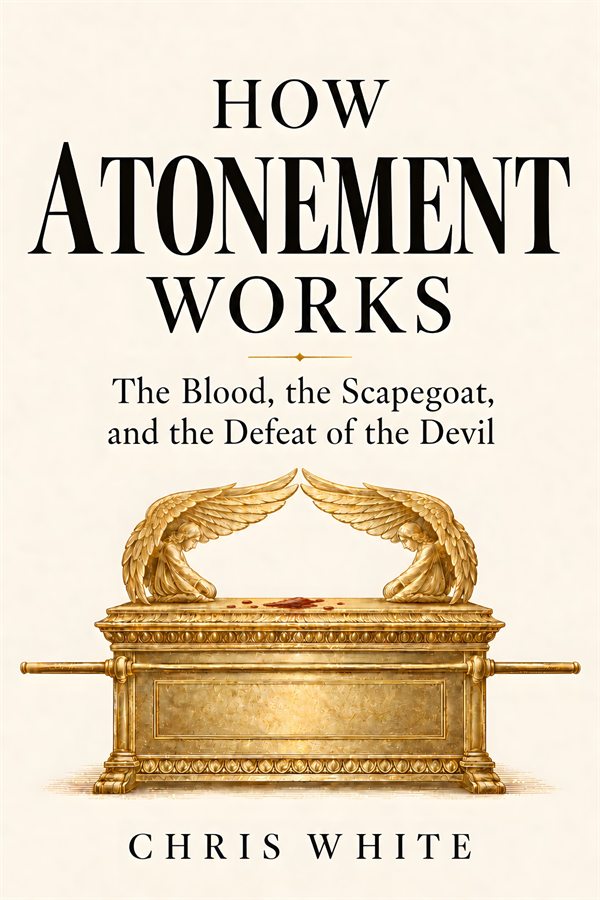
The scapegoat is half of the Day of Atonement. How Atonement Works follows both goats into the work of Christ: the blood brought before God, the sins carried away, and what that did to the devil’s power of death.
Get the Paperback on AmazonHow Other Christians Read the Scapegoat
Not every reader puts Christ in both goats. Many Christians are taught that the atonement was made in one act, Christ’s death on the cross as the sacrifice for sin. On this reading the slain goat pictures his death, and the scapegoat serves as an illustration of the result: sins removed from God’s people and remembered no more. Christian traditions over the centuries have tended to build on one goat or the other more often than on both.
Many Old Testament scholars treat the live goat as a means of disposal. Jacob Milgrom and David Wright, whose work on Leviticus is widely respected, read it as a vehicle that took the sins out of the camp to the wilderness, where nothing lived. Others, reading Isaiah 53 alongside Leviticus, understand the goat’s banishment as a punishment, and take Christ’s bearing of sin to mean bearing its penalty.
These readings hold real truths. Christ’s death is indispensable, the sins did have to leave the camp, and Isaiah does speak of the servant as wounded for our transgressions. The book’s reply rests on Leviticus itself. There, bearing another’s iniquity and dying for it are two different things. The priests and Ezekiel bore iniquity and lived, and the one animal the law says bore the people’s iniquities is the one animal of the day that was kept alive. The book also suggests why: the blood that cleansed God’s house had to be clean, and the goat carrying the sins could not supply it.
So how could Christ, who died, fulfill a goat that lived? The book’s answer is that one person fulfilled both. Isaiah’s servant is already both: an offering for sin, and the one who bears the sin of many. Christ gave his life, and his blood was brought before God. He also bore our sins and carried them away.
Where Christ Carried the Sins
The live goat went outside the camp and on to the land cut off. Hebrews places the cross outside as well: the bodies of the sin offerings were burned outside the camp, “wherefore Jesus also, that he might sanctify the people with his own blood, suffered without the gate” (Hebrews 13:12). Scripture also says Christ went where the dead go. Peter preached that his soul was not left in hell (Acts 2:31), and Paul wrote that he “descended first into the lower parts of the earth” (Ephesians 4:9).
Chris White proposes that the goat’s journey was fulfilled when Christ, bearing the sins of the world, went down to the dead. The psalmist says the dead are “cut off from thy hand” (Psalm 88:5), using the same root Leviticus uses for the goat’s destination. Origen, in the third century, already connected the live goat’s journey into the wilderness with Christ’s descent, and some modern writers have made the same connection.
The book carries the proposal one step further. Most scholars read Azazel, the name at the goat’s destination, as a personal being, and ancient Jewish readers took him to be a fallen angel to whom the sins of the earth were charged. Chris White identifies him with Satan and argues that the sins Christ bore were sent back to their source. He calls this the return to sender, and he presents it as his own synthesis of the texts. The return disposed of the sins, and the devil was paid nothing by it. The book develops this, and what it did to the devil’s power of death, in later chapters.
The Scapegoat and Our Forgiveness
Scripture says Christ bore our sins so that they would be taken away from us. Leviticus gives the result for Israel: “that ye may be clean from all your sins before the LORD” (Leviticus 16:30). Isaiah says the servant shall “justify many; for he shall bear their iniquities” (Isaiah 53:11). Peter says Christ bore our sins “that we, being dead to sins, should live unto righteousness” (1 Peter 2:24).
At the Last Supper Jesus said, “this is my blood of the new testament, which is shed for many for the remission of sins” (Matthew 26:28). The Greek word for remission is aphesis, the word the Greek translators used when they called the goat “set apart for release.”
The transfer ran in one direction. The sins went out on the sin-bearer, and cleansing and the presence of God came to the people through the blood. The one who carried them was innocent, the burden was ours, and what believers receive is to be clean from all their sins. The first goat’s side of that work, Christ’s blood brought before God by the risen high priest, is the subject of why the resurrection is needed for forgiveness.
Where This Understanding Comes From
Seeing Christ in both goats is an old Christian reading. The Epistle of Barnabas, from around the end of the first century, and Justin Martyr, in the middle of the second, both took the slain goat and the sent-away goat as two pictures of the one Lord. Origen and later writers connected the live goat with Christ’s descent to the dead. Among modern writers, Samuel Renihan and Richard Barry both connect the scapegoat with Christ’s descent.
The book’s reading of Leviticus draws on Jacob Milgrom’s commentary, on Baruch Schwartz and Gary Anderson’s work on sin as a burden that is borne, and on Andrei Orlov’s study of the two goats in early Jewish writings. Emma Ford has argued that Isaiah 53 presents the servant as a scapegoat. David M. Moffitt’s work on Hebrews shows the difference between the goat that goes away from God’s presence and the sacrifices brought into it. Michael Heiser suggested the reading of the goat’s destination that the book develops. How Atonement Works builds on this scholarship, credits it, and adds its own account of how the two goats fit together.