The short answer
The filthy garments stand for iniquity. The LORD explains the picture himself when he has them removed: “I have caused thine iniquity to pass from thee” (Zechariah 3:4). Joshua was high priest of a people just back from exile, and the sin on him was real. That is why Satan could stand at his right hand to accuse him. God left the charge undisputed and answered it by taking the sin away and clothing Joshua in clean garments.
What Zechariah Saw
Zechariah prophesied in Jerusalem after the return from Babylon, when the people were rebuilding the temple (Zechariah 1:1; Ezra 5:1). Joshua was the high priest of that returned community. Haggai, who prophesied in the same years, calls him Joshua the son of Josedech (Haggai 1:1). Chapter 3 is one of a series of night visions given to Zechariah, and it opens in a court:
And he shewed me Joshua the high priest standing before the angel of the LORD, and Satan standing at his right hand to resist him. And the LORD said unto Satan, The LORD rebuke thee, O Satan; even the LORD that hath chosen Jerusalem rebuke thee: is not this a brand plucked out of the fire? Now Joshua was clothed with filthy garments, and stood before the angel.
Zechariah 3:1–3
Joshua stands before the angel of the LORD as a man stands before a judge. Satan stands at his right hand, the place of an accuser. The LORD speaks on Joshua’s side. A brand is a burning stick, and one plucked out of the fire has been pulled out just before it burned up. Joshua and the people with him had come through the judgment of the exile and been brought home.
Who Is the Satan at His Right Hand?
The Hebrew word satan means an adversary. The words “to resist him” translate the verb made from the same word: Satan stands at Joshua’s right hand to be his adversary, to accuse him. The book of Job opens in the same kind of court. There Satan presents himself before God, and his first act is an accusation: “Doth Job fear God for nought?” (Job 1:9). Job’s piety, he says, has been bought.
Many Old Testament scholars read “the satan” in Zechariah as a title, an angel who serves as prosecutor in the heavenly court, and they hold that the fuller picture of the devil came later. How Atonement Works reads him as the devil himself, the figure Revelation names when he is thrown down from heaven: “the accuser of our brethren is cast down, which accused them before our God day and night” (Revelation 12:10). On either reading his work in Zechariah 3 is the same. He is there to bring a charge.
Why Were Joshua’s Garments Filthy?
Verse 4 explains the picture. When the LORD orders the filthy garments taken off, he tells Joshua what is being removed: “thine iniquity.” The dirty clothes are sin, made visible.
The contrast with what a high priest should wear is sharp. Exodus describes the high priest’s garments as holy garments, made for glory and for beauty (Exodus 28:2). On the Day of Atonement he put on linen garments after washing his body, so that he could enter the holy place (Leviticus 16:4). Joshua stands in God’s presence in clothes that say the opposite.
Readers have asked whose sin it was. Some take the garments as Joshua’s own sins. Others take them as the guilt of the nation he represented, or as the defilement of years spent in an unclean land. These fit together. The high priest stood for the people, and on the Day of Atonement he made atonement for himself, for his household, and for all the congregation (Leviticus 16:17). Later in the same vision God speaks of removing “the iniquity of that land,” so the sin on Joshua reaches beyond one man. Chris White puts it plainly in the book: Joshua is in filthy garments, so the accusation is true.
How God Answered the Accuser
The LORD rebukes Satan twice, and he gives his reason: he has chosen Jerusalem, and Joshua is a brand he has pulled from the fire. Then he deals with the garments:
And he answered and spake unto those that stood before him, saying, Take away the filthy garments from him. And unto him he said, Behold, I have caused thine iniquity to pass from thee, and I will clothe thee with change of raiment.
Zechariah 3:4
The LORD leaves the charge standing and removes the thing it rests on. The filthy garments come off, the iniquity passes from Joshua, and he is given clean clothing. At Zechariah’s request a clean turban, the KJV’s “fair mitre,” is set on his head, and the angel of the LORD stands by while he is dressed (Zechariah 3:5). Joshua leaves the court cleansed and fit to serve.
Satan was right about the facts. Once the garments are gone, he has nothing left to accuse. This is the Old Testament picture of forgiveness. Isaiah has God say, “I, even I, am he that blotteth out thy transgressions for mine own sake, and will not remember thy sins” (Isaiah 43:25). In Zechariah’s court the blotting out is shown as a change of clothes.
The Rest of the Vision: A Priesthood Restored
Zechariah 3 is first of all a promise to the people who had come back from exile. Their temple was half built and their priesthood had been carried off to Babylon. The vision tells them that God has cleansed their high priest and will use him again.
After Joshua is dressed, the angel of the LORD gives him a charge. If he walks in God’s ways and keeps what God has committed to him, he will govern God’s house and keep his courts, and he will be given a place among those who stand in God’s presence (Zechariah 3:6–7). Joshua and the priests with him are called a sign of something to come. God says he will bring forth “my servant the BRANCH,” sets before Joshua a stone with seven eyes, and promises to remove the iniquity of the land in one day (3:8–9). The vision closes with neighbors inviting one another under the vine and the fig tree, a picture of peace in the land (3:10).
Many Christians have read the Branch and the one day of cleansing as promises fulfilled in Christ. Zechariah later uses the name again of a man who will build the temple of the LORD and be a priest on his throne (Zechariah 6:12–13). The mitre, the stone, and the vine belong to Zechariah’s message of restoration. How Atonement Works draws on one part of the vision, the accusation and its answer.
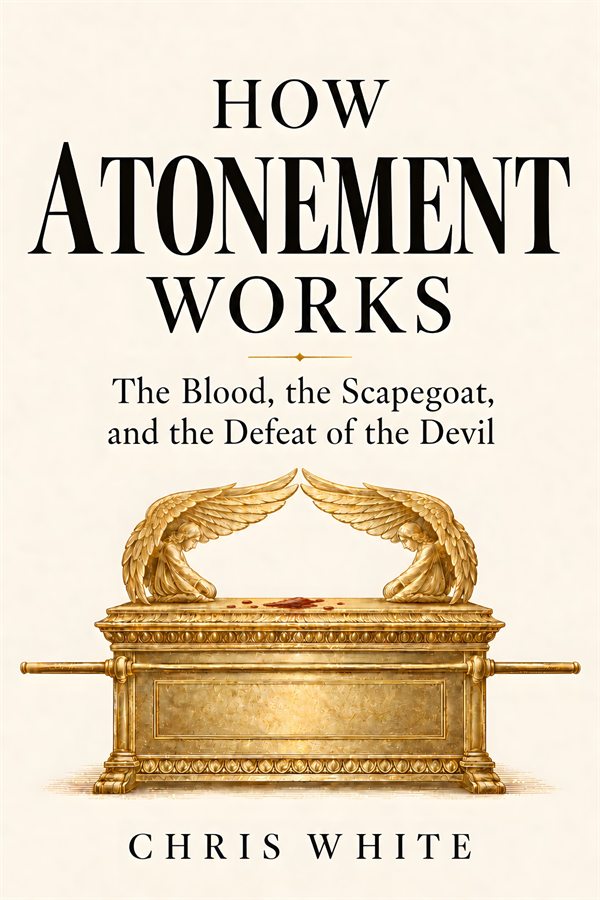
Zechariah’s court is one scene in a larger account. How Atonement Works traces the whole Day of Atonement through the work of Christ: the blood, the high priest in heaven, the scapegoat that carried sins away, and the defeat of the devil.
Get the Paperback on AmazonThe Book’s Reading: An Accuser With a True Charge
In How Atonement Works, Chris White uses Zechariah 3 as the clearest picture in Scripture of how the devil works against God’s people and how God answers him. Accusation follows temptation. The devil tempts a person into sin and then accuses the person of it. The temptation supplies the charge, and the charge is true.
Hebrews says that the devil “had the power of death” (Hebrews 2:14), and Scripture ties death to sin from the garden onward: “the wages of sin is death” (Romans 6:23). The book draws these texts together into a synthesis. Chris White proposes that the devil’s power of death is a hold on people through their sins: where there is a true charge of sin there is a sentence of death, and the devil is the one who brings the charge. No single verse states that whole chain, and the book presents it as its own reading of the texts. The page What does it mean that the devil had the power of death? sets it out more fully.
On that reading, Zechariah’s court shows the problem the atonement had to solve. If the devil’s charges were false, God could simply dismiss them. They are true, and every person who has known good and evil has done evil. The question is how to answer a true charge. Zechariah’s vision gives the answer in a picture. God takes the sin off the accused, and the accuser has nothing left to bring. Paul says that “the sting of death is sin” (1 Corinthians 15:56). With the sin removed, death has lost its sting.
The Same Answer in the New Testament
Revelation describes the accuser’s defeat in the same terms. He is cast down, and the brethren he had accused “overcame him by the blood of the Lamb” (Revelation 12:11). Paul describes forgiveness as the cancelling of a written record that stood against us, and he puts the defeat of the hostile powers in the same sentence:
And you, being dead in your sins and the uncircumcision of your flesh, hath he quickened together with him, having forgiven you all trespasses; blotting out the handwriting of ordinances that was against us, which was contrary to us, and took it out of the way, nailing it to his cross; and having spoiled principalities and powers, he made a shew of them openly, triumphing over them in it.
Colossians 2:13–15
The book reads the handwriting as the record of our sins, the charge sheet an accuser needs. An accuser needs a case, and a case against a sinner is a record of what the sinner did. When the record is blotted out in forgiveness, the principalities and powers are stripped and led in triumph. Jesus told Paul that his mission to the Gentiles was to turn them “from the power of Satan unto God, that they may receive forgiveness of sins” (Acts 26:18). Turning from Satan’s power and receiving forgiveness are one turning.
Zechariah saw the same thing in a single scene. The book develops the New Testament side at length, and the page How does forgiveness defeat Satan? walks through Colossians 2 and Revelation 12 in more detail.
Where This Understanding Comes From
The picture of Satan as the accuser comes straight from Job, Zechariah, and Revelation, and Christians have read the cross as his defeat since the early church. Gustaf Aulén gathered the early writers’ emphasis on Christ’s victory over death and the devil under the name Christus Victor. John Calvin, commenting on Colossians 2, understood the principalities and powers to be devils, disarmed so that they have nothing to bring against believers. Origen, preaching on Leviticus 16, connected the same passage with the Day of Atonement. Jacob Milgrom’s work on Leviticus describes the goat for Azazel as returning evil to its source. How Atonement Works builds on this work and credits it. Its own contribution is the way it joins these threads: an accuser whose power rests on true charges, and a forgiveness that removes them.
What Zechariah 3 Offers Christians Today
The vision is honest about sin. Joshua does not argue that his clothes are clean, and nobody in the court pretends they are. Christians who know their own failures can read Zechariah 3 without having to defend themselves. The answer God gives is cleansing.
It is also good news about the accuser. His case depends on sin that has not been dealt with. Where God has taken the sin away, the charge has nothing to rest on, and the LORD who rebuked Satan in Zechariah’s court is the same God who has forgiven believers “all trespasses” in Christ (Colossians 2:13). The Father “hath delivered us from the power of darkness,” Paul says, and in his Son “we have redemption through his blood, even the forgiveness of sins” (Colossians 1:13–14).