The short answer
Jesus is in the presence of God as our high priest. Hebrews says that after he offered one sacrifice for sins, he sat down at God’s right hand, and that he entered heaven “to appear in the presence of God for us.” He “ever liveth to make intercession” for his people. John calls him “an advocate with the Father.” He does not offer anything new, and the Father he speaks to is willing. His living presence before God keeps believers forgiven and gives them access to the Father.
Seated at the Right Hand of God
After his ascension, the apostles describe Jesus as seated at the right hand of God. Hebrews says it in its opening sentence about the Son: “when he had by himself purged our sins, sat down on the right hand of the Majesty on high” (Hebrews 1:3). The purging came first, and then the sitting.
Hebrews explains what the sitting means by comparing Christ with the priests of Israel:
And every priest standeth daily ministering and offering oftentimes the same sacrifices, which can never take away sins: But this man, after he had offered one sacrifice for sins for ever, sat down on the right hand of God.
Hebrews 10:11–12
The law set the priests apart “to stand before the LORD to minister unto him” (Deuteronomy 10:8). Their work was never done, so they never sat. Christ sat down because his offering was complete and will never be repeated. Hebrews still calls him a minister of “the true tabernacle, which the Lord pitched, and not man” (Hebrews 8:2). He is at rest from offering, and he is still at work as a priest.
He Appears in the Presence of God for Us
Hebrews says that Christ entered “into heaven itself, now to appear in the presence of God for us” (Hebrews 9:24). He went in as a forerunner “for us” (Hebrews 6:20). Everything he does there, he does on behalf of the people he represents.
The contrast with Israel’s high priest shows what his presence there means. Aaron could enter the holy of holies once a year. He offered a bull for his own sin first, and a cloud of incense covered the lid of the Ark “that he die not” (Leviticus 16:2, 12–13). When he had put the blood on the lid, he came out. Hebrews sets the new priest against that picture:
And they truly were many priests, because they were not suffered to continue by reason of death: But this man, because he continueth ever, hath an unchangeable priesthood.
Hebrews 7:23–24
Jesus is a priest “after the power of an endless life” (Hebrews 7:16), a life death could not hold. He is holy and has no sin of his own, so he needs no offering for himself and nothing to shield him. He entered once, and he has stayed. (The page Why Is Jesus Called Our High Priest? explains this priesthood and its link to Melchizedek.)
Hebrews also says what he brought in. He entered “by his own blood” (Hebrews 9:12), and he “offered himself” (Hebrews 9:14). Leviticus teaches that “the life of the flesh is in the blood” (Leviticus 17:11), and that the blood atones because of the life in it. What Christ brought into God’s presence was his own life, laid down at the cross and taken up again. His life is before God because he himself is there.
Some readers wonder whether Jesus is still sprinkling blood in heaven. The high priest entered every year, and Hebrews says that Christ appeared once “to put away sin by the sacrifice of himself” (Hebrews 9:25–26). Interpreters have long differed over whether Christ carried his blood into heaven as a separate act, and Chris White thinks it quite possible that he did once in the true sanctuary what the high priest did in its copy. What Hebrews describes is the person: Christ, who was offered, is alive in God’s presence.
What “He Ever Liveth to Make Intercession” Means
Hebrews 7:25 says that Jesus “is able also to save them to the uttermost that come unto God by him, seeing he ever liveth to make intercession for them.” Paul says the same: “It is Christ that died, yea rather, that is risen again, who is even at the right hand of God, who also maketh intercession for us” (Romans 8:34). The New Testament describes this intercession in two ways.
Some passages speak of prayer. On the night before he died, Jesus told Peter:
Simon, Simon, behold, Satan hath desired to have you, that he may sift you as wheat: But I have prayed for thee, that thy faith fail not: and when thou art converted, strengthen thy brethren.
Luke 22:31–32
Peter denied him three times that night. After the resurrection Jesus asked him three times whether he loved him and gave him back his work: “Feed my sheep” (John 21:15–17). Peter fell, and his faith did not fail. Many Christians have seen in this scene the best picture of what Christ still does for his people at the right hand of God.
Other passages describe the intercession as his presence. He entered heaven “now to appear in the presence of God for us” (Hebrews 9:24). Some of the historic confessions describe Christ’s intercession chiefly as his appearing in our nature before the Father.
How Atonement Works holds that both descriptions are true and describe one ministry. Chris White reads Hebrews this way: because Jesus lives and is holy, he can stay in the presence of God, and his staying there is what Hebrews calls his intercession. He is also a living man who speaks to his Father for his people, as he did on earth. What he asks carries the weight of who he is, the atoning sacrifice present before God.
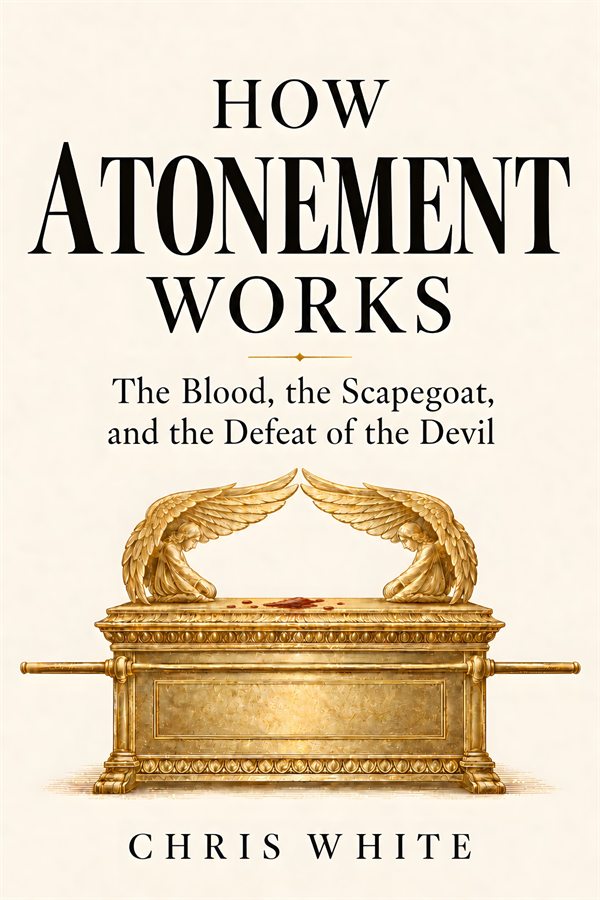
Christ’s work in heaven is one part of a larger account. How Atonement Works traces the whole Day of Atonement through the work of Christ: the blood, the high priest in heaven, the scapegoat that carried sins away, and the defeat of the devil.
Get the Paperback on AmazonThe Father Is Willing
Some Christians picture Christ’s intercession as a son pleading with an angry father, holding him back from judgment. The New Testament gives a different picture. The atonement came from the Father. “All things are of God, who hath reconciled us to himself by Jesus Christ” (2 Corinthians 5:18). John writes:
Herein is love, not that we loved God, but that he loved us, and sent his Son to be the propitiation for our sins.
1 John 4:10
Leviticus said the same of the blood: God told Israel, “I have given it to you upon the altar to make an atonement for your souls” (Leviticus 17:11). The means of atonement was God’s own gift. Paul says that “God commendeth his love toward us, in that, while we were yet sinners, Christ died for us” (Romans 5:8). On the night before he died, Jesus prayed that the world would know that the Father has “loved them, as thou hast loved me” (John 17:23).
Christ does not have to persuade a reluctant Father, and he does not have to offer anything new. His intercession is the ministry of a Son whom the Father sent, standing for people the Father loves.
Our Advocate With the Father
John describes Christ’s work in heaven in personal terms:
My little children, these things write I unto you, that ye sin not. And if any man sin, we have an advocate with the Father, Jesus Christ the righteous: And he is the propitiation for our sins: and not for ours only, but also for the sins of the whole world.
1 John 2:1–2
John writes to “my little children,” and he writes first of all “that ye sin not.” He also knows they will fail: “If we say that we have no sin, we deceive ourselves” (1 John 1:8). When one of them does sin, he already has an advocate with the Father. The Greek word for “advocate” is the word the King James Version translates “Comforter” when Jesus speaks of the Holy Spirit (John 14:16). The advocate is himself the propitiation for that sin, alive and in the Father’s presence. So John can promise that if we confess our sins, God “is faithful and just to forgive us our sins” (1 John 1:9).
Chris White connects this with the way Israel’s relationship with God was kept. Two lambs were offered “day by day continually,” morning and evening, at the door of the tabernacle (Exodus 29:38, 42). When an Israelite learned of a sin, he brought an offering, and “it shall be forgiven him” (Leviticus 4:31). Under the new covenant there is “no more offering for sin” (Hebrews 10:18), because the one offering has been made and the priest who is that offering remains before God. Believers still sin, and Jesus taught them to ask for forgiveness as they ask for daily bread (Luke 11:3–4). The book argues that Christ’s advocacy keeps the reconciliation, as Israel’s daily offerings kept theirs. In the book’s words, believers keep their relationship with God “day by day, in Jesus’ name, at the throne where the offering already is.”
That is also why the resurrection is part of forgiveness. A dead Christ could be no advocate. The page on the resurrection and forgiveness follows that question through 1 Corinthians 15:17.
The Throne of Grace, and Believers in Him
Because Christ is in God’s presence, his people are invited in as well:
Let us therefore come boldly unto the throne of grace, that we may obtain mercy, and find grace to help in time of need.
Hebrews 4:16
The verse before says that our high priest “was in all points tempted like as we are, yet without sin,” and can be “touched with the feeling of our infirmities” (Hebrews 4:15). The Greek word for “boldly” describes people who speak freely and come in without fear. Hebrews says it again later: believers have “boldness to enter into the holiest by the blood of Jesus, by a new and living way . . . through the veil, that is to say, his flesh” (Hebrews 10:19–20).
In Israel’s sanctuary God was pictured as enthroned between the cherubim over the lid of the Ark (1 Samuel 4:4), the place where the blood was put on the Day of Atonement. The book argues that the throne at whose right hand Christ sat down is the true counterpart of that lid. John saw “in the midst of the throne . . . a Lamb as it had been slain” (Revelation 5:6). The throne of grace is the place of atonement, and Christ, who was offered, is there.
The book also explains how believers come to that throne. Aaron carried “the names of the children of Israel in the breastplate of judgment upon his heart” when he went into the holy place (Exodus 28:29), and the people stayed outside. Christ presents his people more fully: “Behold I and the children which God hath given me” (Hebrews 2:13). The New Testament says that believers are “in him.” Their life “is hid with Christ in God” (Colossians 3:3), and through him they “have access by one Spirit unto the Father” (Ephesians 2:18). Chris White reads this union as the reason believers share Christ’s place before the Father. They come in Christ, who is already there. The book holds that this access belongs to those who remain in him: “If ye abide in me, and my words abide in you, ye shall ask what ye will, and it shall be done unto you” (John 15:7).
How Other Christians Describe His Work in Heaven
Christians across the traditions agree on much of this. Jesus is risen, ascended, and seated at the right hand of God. He intercedes for his people. His sacrifice was made once and is never repeated.
Many Christians, especially in Protestant churches, teach that the atoning work was completed at the cross when Jesus said, “It is finished” (John 19:30). On that view the resurrection is God’s vindication of the finished sacrifice, and Christ’s ministry in heaven applies its benefits: he prays for his people, presents their prayers, and secures what the cross obtained. This is a serious reading of Scripture, held by careful teachers, and it gives Christ’s intercession a real place.
How Atonement Works agrees that the sacrifice is complete and that the cross is indispensable. It differs on where Hebrews places the completion. Hebrews ties the purging of sins to his sitting down at God’s right hand (Hebrews 1:3), and it places his offering at his entrance into heaven (Hebrews 9:12, 24–26). The book reads “It is finished” as the work the Father gave the Son to do on earth, and it holds that the risen priest presented in heaven the life he gave in death. On this reading Christ’s present work in heaven is the continuing ministry of the same atonement.
Until He Comes Out
On the Day of Atonement no one was allowed in the tabernacle while the high priest made atonement in the holy place, “until he come out” (Leviticus 16:17). The people waited outside. Christ has entered, and he has not yet come out. Hebrews looks ahead to that day:
Unto them that look for him shall he appear the second time without sin unto salvation.
Hebrews 9:28
Those who wait for him have what Israel did not have while it waited. They have already been brought near. They may come boldly to the throne of grace. They have an advocate with the Father. And the exalted Christ, “being by the right hand of God exalted,” has poured out the Holy Spirit (Acts 2:33), so that the God who once dwelt in a tent among his people now dwells in them. When he appears, those who are his will be raised as he was raised (1 Corinthians 15:23).
Right now Jesus is alive in the presence of God, at the place of atonement, for his people. Because he is there, a believer who sins can confess it and be forgiven, a believer who is tempted can ask for help, and every believer can come to the Father in his name.
Where This Understanding Comes From
The book’s account of Christ’s present work draws on others. David M. Moffitt’s work on Hebrews, including Rethinking the Atonement (2022), argues that the risen Jesus entered the heavenly sanctuary and presented himself before God, and that he never has to leave the Father’s presence to present himself again. F. F. Bruce saw Christ’s prayer for Peter as a picture of his intercession, and Peter Orr has written on the risen and ascended Christ and his prayer for believers. The Westminster Larger Catechism describes the intercession as Christ’s continual appearing before the Father. Jacob Milgrom’s study of Leviticus explains how blood cleansed the sanctuary so that God could keep dwelling with his people. Early Christian writers understood Christ’s offering to include his presentation in heaven. How Atonement Works builds on this work and credits it.