The short answer
On the Day of Atonement the high priest went into the holy of holies alone, and no one else could be in the tabernacle “until he come out” (Leviticus 16:17). Hebrews 9 describes Christ as the high priest who entered heaven itself by his own blood. He went in once, and he is there now, in the presence of God for us. Hebrews 9:28 promises that he “shall appear the second time” to those who look for him. His return is the high priest coming out.
Hebrews 9:28 in Its Setting
Hebrews 9 is about the Day of Atonement. The writer describes the tabernacle Moses built, with its outer room and the inner room behind the veil. Into the inner room “went the high priest alone once every year, not without blood” (Hebrews 9:7). Then he says that Christ did what that high priest did:
Neither by the blood of goats and calves, but by his own blood he entered in once into the holy place, having obtained eternal redemption for us.
Hebrews 9:12
The last verses of the chapter use the word “appear” three times, each for a different part of Christ’s work. Once in the end of the world “hath he appeared to put away sin by the sacrifice of himself” (Hebrews 9:26). He entered “into heaven itself, now to appear in the presence of God for us” (Hebrews 9:24). And he will appear again:
So Christ was once offered to bear the sins of many; and unto them that look for him shall he appear the second time without sin unto salvation.
Hebrews 9:28
The first appearing is his coming in the flesh and his death. The second is his presence before God now. The third is his return. The chapter follows the high priest into the holy place, and it closes with the priest appearing again to the people who wait for him.
The High Priest Went In Alone
Leviticus 16 gives the order of the Day of Atonement. It opens with the death of two of Aaron’s sons, who came before the LORD with strange fire, and it warns Aaron not to come into the holy place at all times, “that he die not” (Leviticus 16:1–2). Once a year he went in. He took incense, so that its cloud would cover the lid of the Ark, and he took blood, which he sprinkled on the lid and before it (Leviticus 16:12–15). With that blood he made “an atonement for the holy place, because of the uncleanness of the children of Israel” (Leviticus 16:16).
While he did this, no one else was allowed in the tent:
And there shall be no man in the tabernacle of the congregation when he goeth in to make an atonement in the holy place, until he come out, and have made an atonement for himself, and for his household, and for all the congregation of Israel.
Leviticus 16:17
Aaron was alone with the blood. The people he was making atonement for stood outside. The veil hid what he did, so they could not watch it. They knew he had gone in, and they waited for him to come out.
When the High Priest Came Out
The blood was applied in the holy of holies, then in the tent, then on the altar in the court. The live goat was sent away into the wilderness with the people’s sins on it. Then Aaron went back into the tent. He took off the linen garments he had worn behind the veil and left them there, washed, and put on his own garments again. He came out and offered his burnt offering and the people’s, to “make an atonement for himself, and for the people” (Leviticus 16:23–24).
The high priest who came out was alive. He had gone where Aaron’s sons had died, he had done what the day required, and he stood before the people again. Leviticus states what the day had done for them:
For on that day shall the priest make an atonement for you, to cleanse you, that ye may be clean from all your sins before the LORD.
Leviticus 16:30
Christ Has Entered and Has Not Yet Come Out
Aaron went in once a year and came out every year. He was mortal and sinful, and he could stay in God’s presence only briefly, behind a cloud of incense. Christ is holy, and Hebrews says he became a priest “after the power of an endless life” (Hebrews 7:16). He can remain in God’s presence, and he does.
Hebrews also says that he will not repeat his entrance “as the high priest entereth into the holy place every year with blood of others” (Hebrews 9:25). He entered once, offered one sacrifice for sins, and “sat down on the right hand of God” (Hebrews 10:12). In the words of the book, “Christ entered once and has not come out.” His remaining there is what Hebrews calls his intercession: “he ever liveth to make intercession for them” (Hebrews 7:25). The page on what Jesus is doing in heaven now explains that intercession more fully.
Chris White draws the comparison with the high priest coming out in the conclusion of How Atonement Works. Verse 28 names no high priest. The comparison comes from the passage around it, which follows the high priest from his entrance with the blood to his appearing again. On this reading, the time between Christ’s ascension and his return answers to the time Israel waited outside the tabernacle. The high priest is inside, in the presence of God. His work there is for his people. And he will come out.
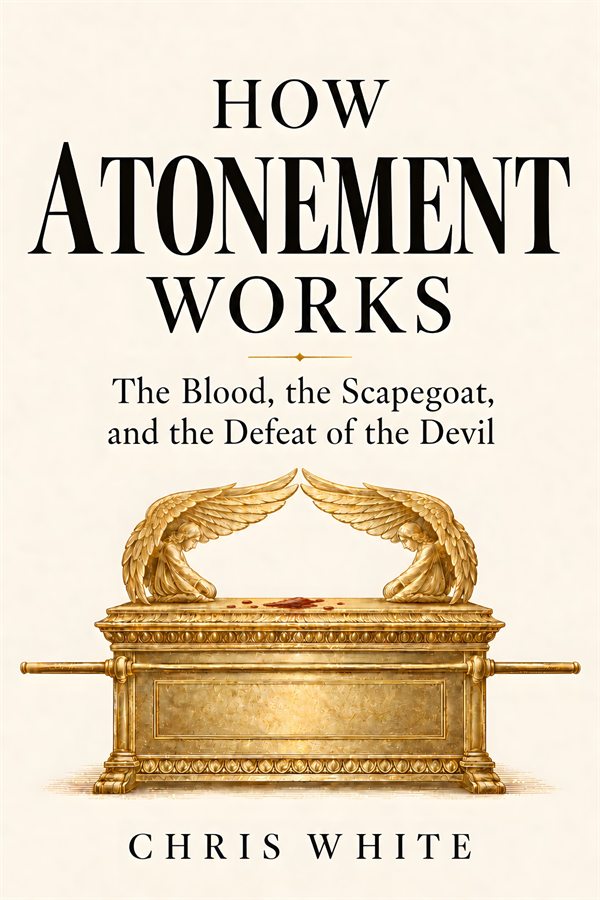
This question is one step in a larger account. How Atonement Works follows the whole Day of Atonement through the work of Christ: the blood, the high priest in heaven, the scapegoat that carried sins away, and the defeat of the devil.
Get the Paperback on AmazonThose Who Wait Have Already Been Brought Near
Here the picture and its fulfillment part ways. Israel waited outside the veil and could not follow the high priest in. Christians also wait for their high priest to come out, and they already have what Israel lacked while it waited. Hebrews says they have “boldness to enter into the holiest by the blood of Jesus” (Hebrews 10:19), and it tells them to come:
Let us therefore come boldly unto the throne of grace, that we may obtain mercy.
Hebrews 4:16
They can draw near because they are in Christ, and Christ is there. Aaron carried the names of the tribes on his breastplate when he went into the holy place (Exodus 28:29). The names went in, and the people stayed outside. Christ’s people are themselves in him.
When they sin, they have “an advocate with the Father, Jesus Christ the righteous” (1 John 2:1). The Spirit he poured out lives in them, as God promised through Ezekiel: “I will put my spirit within you, and cause you to walk in my statutes” (Ezekiel 36:27). The God who asked Israel for a sanctuary so that he could dwell among them now dwells in his people.
So the people who wait in Hebrews 9:28 have been forgiven and brought near, and they look for the rest of what was promised. For how Hebrews presents Jesus as high priest in the first place, see Jesus our high priest.
“Without Sin unto Salvation”
The words “without sin” look back to the first half of the verse. Christ was “once offered to bear the sins of many.” That was done once. When he appears the second time, he comes for another purpose, “unto salvation.”
Bearing the people’s sins was the work of the second goat on the Day of Atonement, the goat that carried Israel’s iniquities away into the wilderness (Leviticus 16:21–22). The book reads the first half of Hebrews 9:28 with that goat in view. The second half looks to the end of the day, when the high priest came out to the people.
The salvation he brings at his appearing is the completion of what he began. Believers are forgiven now and indwelt by the Spirit, and their bodies still die. Paul says that those who belong to Christ will be raised at his coming (1 Corinthians 15:23), and that death, “the last enemy,” will be destroyed (1 Corinthians 15:26). The book closes on this hope: when the high priest appears, those who are his will be raised as he was raised.
Hebrews describes the people who receive this salvation as “them that look for him.” It is a description of their hope. Jesus told his disciples that no one knows the day or the hour (Matthew 24:36), and the picture of the high priest offers no calendar. It tells the waiting people who is coming and what he brings: salvation, from the one who has already borne their sins.
How Other Christians Read Hebrews 9:28
Many Christians read Hebrews 9:28 as a plain promise of the second coming, set beside the verse before it. Verse 27 says that people die once and after that comes the judgment. On that reading, the writer’s point is the pattern of once and afterward: people die once and then face judgment, and Christ was offered once and will come again to save. That reading is sound, and it sits comfortably with the picture of the high priest. One sentence can carry both. The book adds the setting of the whole chapter, which follows Israel’s high priest into the holy place and out again.
A second difference concerns when the atoning work was completed. Many Christians, especially those who teach penal substitution, place its completion at the cross and see Christ’s present work in heaven as the application of what the cross accomplished. They agree with the book that the sacrifice is complete and is never repeated, as Hebrews insists. Chris White follows Hebrews in placing Christ’s offering at his entrance into heaven (Hebrews 9:12, 24) and the purging of sins with his sitting down at the right hand (Hebrews 1:3), and he holds the cross to be indispensable to that offering. The page on the resurrection and forgiveness sets out that view. On either account, Christ is now at the right hand of God, and his people wait for him.
Where This Understanding Comes From
The comparison draws on a long line of readers. Early Christian writers, among them the author of the Epistle of Barnabas and Justin Martyr, read the two goats of the Day of Atonement as pictures of Christ, and Justin connected them with Christ’s two appearances, first in suffering and then in glory. David M. Moffitt’s work on Hebrews, including Rethinking the Atonement (2022), argues that the risen Jesus entered the heavenly sanctuary and presented himself before God, and that he has no need to leave the Father’s presence and return to present himself again. Jacob Milgrom’s commentary on Leviticus explains the Day of Atonement as the cleansing of God’s dwelling with blood. How Atonement Works builds on this work and credits it, and its conclusion connects these lines to Hebrews 9:28 and the hope of Christ’s return.