The short answer
The Bible calls the devil the tempter and the accuser, and it says that sin brings death. Chris White’s book How Atonement Works joins these statements into one account: the devil’s power of death was a limited authority, permitted by God, that rested on people’s real sins and was exercised by accusing them before God. He could not kill at will. When Christ bore our sins and God forgave them, the charge was gone, and the devil lost his power over those who are in Christ.
What Hebrews 2:14–15 Says
The verse comes near the end of an argument about the Son and the angels. The writer reads Psalm 8, which says that God made man a little lower than the angels and put all things under his feet, and he admits that “we see not yet all things put under him” (Hebrews 2:8). What we do see is Jesus, “made a little lower than the angels for the suffering of death,” so that he “should taste death for every man” (2:9). The Son became a man so that he could die. Then the writer gives a reason for it:
Forasmuch then as the children are partakers of flesh and blood, he also himself likewise took part of the same; that through death he might destroy him that had the power of death, that is, the devil; And deliver them who through fear of death were all their lifetime subject to bondage.
Hebrews 2:14–15
The word translated “destroy” means to make something inoperative, to put it out of action. Paul uses the same Greek verb when he says that “the last enemy that shall be destroyed is death” (1 Corinthians 15:26). Christ put the devil out of action with respect to the power Hebrews names, his power of death. The devil himself still exists, and Peter could still warn that he “walketh about, seeking whom he may devour” (1 Peter 5:8).
The phrase “through death” is the puzzle. If the devil held the power of death, a death looks like his victory, and the Gospels say that Satan worked to bring the crucifixion about: “Then entered Satan into Judas” (Luke 22:3). Yet Hebrews says that this death disabled him. Hebrews states the power and its defeat. The rest of Scripture describes the devil’s part in death from the garden onward, and those passages explain what the power was.
Death Began With a Temptation
God told Adam that he could eat from every tree in the garden but one: “for in the day that thou eatest thereof thou shalt surely die” (Genesis 2:17). The serpent contradicted him: “Ye shall not surely die” (3:4). Revelation later names that serpent “the Devil, and Satan” (12:9). Adam and Eve ate, their eyes were opened, and God told Adam, “for dust thou art, and unto dust shalt thou return” (3:19).
Jesus called the devil “a murderer from the beginning” (John 8:44), and a Jewish writer shortly before Christ said that death came into the world through the devil’s envy. The murder in the garden was done with a temptation. The devil led Adam and Eve into the sin that God had said would bring death.
The book reads the opened eyes as the awakening of moral awareness. Once a person knows that a thing is wrong, doing it is a transgression that can be charged. Paul wrote, “The sting of death is sin; and the strength of sin is the law” (1 Corinthians 15:56).
What passed down from Adam is a disputed question. Augustine taught that all sinned in Adam, so that his guilt passes to every descendant, and much of Western theology followed him. John Chrysostom read Romans 5:12 as saying that Adam’s descendants became mortal, and the Eastern churches distinguish the mortality we inherit from the guilt each person bears for his own sins. The book takes the second view, with Ezekiel: “The soul that sinneth, it shall die. The son shall not bear the iniquity of the father” (Ezekiel 18:20). On that view, any charge the devil can bring against a person concerns that person’s own sins.
The Tempter Works Within God’s Limits
After the garden the devil goes on doing what he did there. Matthew calls him “the tempter” (Matthew 4:3), and Paul uses the same title (1 Thessalonians 3:5). Scripture also shows that his activity is permitted and bounded by God. In Job the satan is given leave to act against Job, and the leave has a limit:
And the LORD said unto Satan, Behold, all that he hath is in thy power; only upon himself put not forth thine hand.
Job 1:12
When the first trial fails, God sets a new limit: “Behold, he is in thine hand; but save his life” (Job 2:6). Jesus told Peter, “Satan hath desired to have you, that he may sift you as wheat,” and added that he had prayed for him (Luke 22:31–32).
The devil cannot kill whomever he likes. He could not take Job’s life, and his access to the disciples came by request. Whatever power of death he held, he held it under God, who set its limits.
Scripture gives a reason for the permission, and the reason is testing. Moses told Israel that the forty years in the wilderness were “to humble thee, and to prove thee, to know what was in thine heart” (Deuteronomy 8:2). The risen Christ told the church at Smyrna, “the devil shall cast some of you into prison, that ye may be tried” (Revelation 2:10). God tests to prove what is in a person. The devil tempts to make a person fall. The same event can be both.
The Accuser Before God
The Hebrew word satan means an adversary, and where he appears by that name before God, the setting is a court. In Job his first act is an accusation: “Doth Job fear God for nought?” (Job 1:9). Zechariah saw the same court:
And he shewed me Joshua the high priest standing before the angel of the LORD, and Satan standing at his right hand to resist him.
Zechariah 3:1
“To resist him” translates a verb made from Satan’s own name: he stood there as Joshua’s accuser. Joshua was clothed in filthy garments, so the charge was true. Revelation calls the devil “the accuser of our brethren . . . which accused them before our God day and night” (Revelation 12:10).
The tempter and the accuser are the same figure. Having tempted a person into sin, he brings the sin as a charge. In the book’s words, “the temptation supplies the charge, and the charge is true.” That truth is what makes the accusation dangerous. God could dismiss a false charge. A true one has to be answered.
What the Power of Death Was
Scripture says four things plainly. The devil tempts. The devil accuses. Sin brings death: “the wages of sin is death” (Romans 6:23), and “sin, when it is finished, bringeth forth death” (James 1:15). And the devil had the power of death. No single passage joins all four. Chris White proposes a synthesis that joins them, and he holds it as the best explanation of these texts: the devil’s power of death was a death-dealing authority conditioned on sin, exercised by accusation before God, and permitted by God for as long as the charge stood.
On this account the devil’s hold on a person runs through that person’s own sins. Where there is a true charge of sin, a sentence of death follows, and he is the one who brings the charge. He holds his power the way an accuser holds a case. He can press it only where there is something to press, and only before a judge who permits him to speak.
Three things follow from this, and they keep the account within the bounds Scripture sets:
- The power is limited. The devil does not decide on his own who dies. Job’s life was kept from him by God’s word, and the risen Christ now holds “the keys of hell and of death” (Revelation 1:18).
- Nothing is owed to him. God is neither the devil’s debtor nor his partner, and the devil owns no one by right.
- It concerns a charge before God. It offers no way to read the cause of a particular illness or death. Everyone inherits mortality from Adam, the forgiven included.
How Other Christians Have Explained It
Christians have always agreed that Christ defeated death and the devil. The early church proclaimed the victory with pictures such as a ransom and a fishhook, and its writers explained it in different ways. Some said a ransom was paid to the devil; others denied that God owed him anything. The view now called Christus Victor keeps the victory where Hebrews puts it, in Christ’s death, descent, and rising, though it says little about what the devil’s power consisted of.
Penal substitution gives the most common answer today. On that view the devil’s power over people is their guilt under God’s law. His accusation is true, and the sentence of death stands against the guilty. When Christ bore the penalty of sin in the place of sinners, the sentence was carried out, and the devil has nothing left to charge against those who are in Christ. John Calvin connected Hebrews 2:15 to Christ’s victory over the fear of death in this setting.
The book shares much of this. The accusation rests on real sin, and it fails once the sin is dealt with. The difference lies in what removes the charge. In penal substitution the sentence is satisfied by being carried out on a substitute. In the book’s account the sins are carried away and forgiven, as they were on the Day of Atonement.
Recent scholarship has read Hebrews 2:14–15 with Passover in view. David Moffitt has shown that Jewish readers before Christ took the destroyer of Egypt’s firstborn to be an evil angel, and Katie Marcar has argued that Hebrews pictures Christ leading the dead out of bondage as Moses led Israel out of Egypt. The book accepts much of this. It also observes that in Exodus the blood on the doorposts kept the destroyer out without disarming him, so Passover pictures the escape more clearly than the defeat.
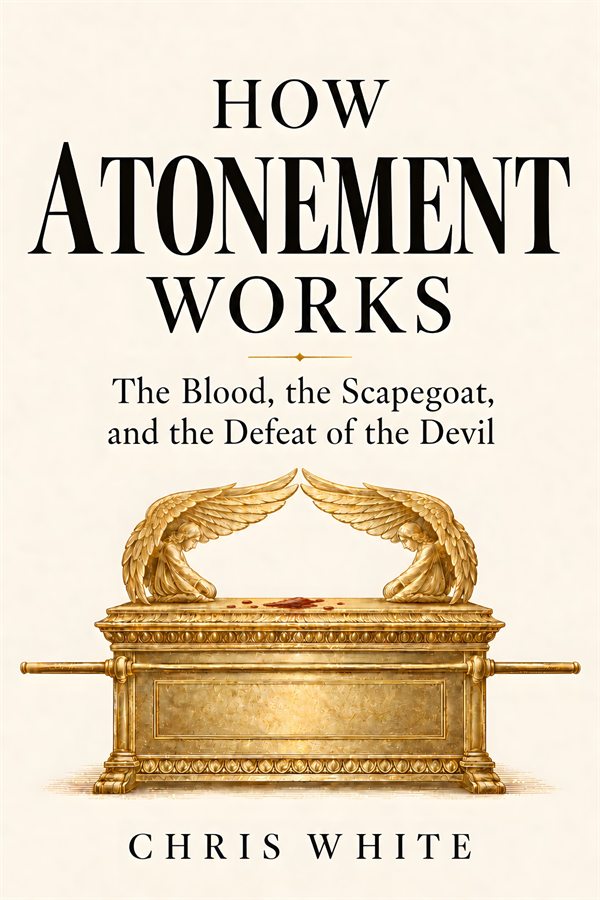
This question sits at the center of the book. How Atonement Works follows the devil’s power of death from the garden to the cross, and shows how the two goats of the Day of Atonement explain both the cleansing of God’s house and the defeat of the accuser.
Get the Paperback on AmazonHow Christ’s Death Took the Power Away
If the devil’s power rested on sin, it ends where the sin is taken away. Paul describes that in Colossians:
And you, being dead in your sins and the uncircumcision of your flesh, hath he quickened together with him, having forgiven you all trespasses; blotting out the handwriting of ordinances that was against us, which was contrary to us, and took it out of the way, nailing it to his cross; and having spoiled principalities and powers, he made a shew of them openly, triumphing over them in it.
Colossians 2:13–15
Forgiveness comes first in Paul’s sentence, and the stripping of the powers follows. The book reads the handwriting as the record of the charges against us. With the record blotted out, the accuser had nothing to bring. Zechariah’s vision gave the same answer long before: the LORD answered the accuser by having the filthy garments removed. “Take away the filthy garments from him,” he said, and to Joshua, “I have caused thine iniquity to pass from thee” (Zechariah 3:4). Revelation says that the brethren “overcame him by the blood of the Lamb” (12:11). The page How Does Forgiveness Defeat Satan? sets out this part of the argument in full.
The book connects this to the second goat of the Day of Atonement. The live goat carried Israel’s confessed sins out of the camp. Christ, bearing the sins of the world, went out of the gate to the cross and down among the dead, and Chris White proposes that he carried those sins back to their source, the devil who brought sin into the world. The descent is discussed in Did Jesus Descend Into Hell?
This also explains the words “through death.” The sins could not be carried away by someone who stayed alive. The devil, who held death, could not keep out of his own territory the one who entered it carrying the sins on which his power rested.
Jesus had said before the cross, “the prince of this world cometh, and hath nothing in me” (John 14:30). The devil had no charge against Jesus himself. Why he still pressed for the death that defeated him is taken up in Why Did Satan Want Jesus Crucified?
Nothing in this was paid to the devil. A record that is blotted out is a debt forgiven, and the captives were released with no price going to the captor. The risen Christ says that he “was dead,” and he now has “the keys of hell and of death” (Revelation 1:18).
Why the Devil Is Still Active, and Why Believers Still Die
Every New Testament letter that mentions the devil after the resurrection treats him as active. He blinds the minds of unbelievers (2 Corinthians 4:4), and believers are told to resist him (James 4:7). The book’s account explains this. What Christ’s death took from him was the charge against those who are in Christ. Over those still under the charge his activity continues within the same limits as before, until he is thrown into the lake of fire (Revelation 20:10). Believers are still tempted, because the testing still counts.
Believers also still die, and Chris White calls this the hardest question for his account. Part of the answer is that mortality came to us from Adam and the resurrection is still ahead: “The last enemy that shall be destroyed is death” (1 Corinthians 15:26). His further suggestion, which he offers as his best guess, is that our bodies still die because we still sin, while the charge against us has been forgiven. Paul says that even where Christ dwells, “the body is dead because of sin; but the Spirit is life because of righteousness” (Romans 8:10). The death that comes to a believer has no sting and no accuser behind it.
Hebrews names what this means for the living. Christ came to “deliver them who through fear of death were all their lifetime subject to bondage” (Hebrews 2:15). A Christian still faces death, and faces it as someone whose sins are forgiven and whose Lord holds the keys.
Where This Understanding Comes From
Christ’s victory over death and the devil was proclaimed widely in the early church, and Gustaf Aulén later gave that view the name Christus Victor. John Calvin tied Hebrews 2:15 to Christ’s victory over the fear of death. On the garden, the book draws on William Hess’s reading of the opened eyes as moral awareness and on John Chrysostom’s reading of Romans 5:12. On Hebrews 2, it builds on David Moffitt’s work on Passover and the defeat of the devil and on Katie Marcar’s 2025 article on Christ’s descent and the harrowing of Hades in Hebrews. Samuel Renihan and Richard Barry have connected the scapegoat with Christ’s descent. The account of the power of death as resting on sin and true accusation, and of forgiveness as what removed it, is Chris White’s synthesis of these texts in How Atonement Works.