The short answer
All Christians confess that Christ died for our sins. The theories explain how that death saves. The early church held recapitulation, victory over death and the devil, ransom, sacrifice and substitution together. Anselm’s satisfaction view (around 1098) made sin a debt of honor owed to God. Abelard stressed the love that draws us back to God. The Reformers turned satisfaction into penal substitution. Grotius offered the governmental view, and Gustaf Aulén revived Christus Victor in 1930.
What the New Testament Says About the Cross
The New Testament describes Christ’s death in many ways. Jesus said that he came “to give his life a ransom for many” (Mark 10:45). Peter wrote that Christ “his own self bare our sins in his own body on the tree” (1 Peter 2:24). Hebrews says that through death he destroyed “him that had the power of death, that is, the devil” (Hebrews 2:14), and that “by his own blood he entered in once into the holy place” (Hebrews 9:12). Paul speaks of reconciliation (Romans 5:10–11) and of God commending “his love toward us, in that, while we were yet sinners, Christ died for us” (Romans 5:8).
A theory of atonement tries to show how these statements fit together: what the human problem was, and how Christ’s death and what followed it solved that problem. The early ecumenical councils defined who Christ is. They did not define how his death secured atonement, so faithful Christians have held several explanations.
Recapitulation and Victory in the Early Church
Irenaeus, a bishop in Gaul writing around AD 180, described Christ’s work as recapitulation. The word means summing up or going over again. Adam had failed. Christ went over the same ground as a man and succeeded where Adam failed, so that the image and likeness of God lost in Adam could be recovered in Christ.
For Irenaeus this was also a war. Christ fought the enemy who had led humanity away captive in Adam. Irenaeus spoke of Christ’s blood as the price of our redemption as well. He held these ideas together and did not rank them.
In the fourth century Athanasius of Alexandria described the human problem as death and corruption. The Word took a mortal body so that by his own death he could overcome death and corruption in that body. Many early writers saw the devil as the one who held humanity in that condition, reading texts like Hebrews 2:14–15, and for them the cross was central to his defeat.
Early writers also taught Christ’s descent to the dead, later confessed in the Apostles’ Creed, and several counted his presentation of himself to the Father in heaven as part of his atoning offering.
Ransom and Substitution in the Early Church
Jesus’ words about giving his life “a ransom for many” led early writers to ask who received the ransom. Some answered that it was paid to the devil, who held humanity captive. This is usually called the ransom theory.
Gregory of Nyssa developed it in the late fourth century. He reasoned that the devil would not have accepted God openly, so Christ’s divinity was hidden in his human nature. He compared it to a fishhook hidden in bait. The devil swallowed the flesh, and the life hidden in it overthrew death from within.
Other early writers rejected the idea. Gregory of Nazianzus, from the same circle, asked to whom Christ’s blood was offered. He called a payment to the devil an outrage, and he doubted that the Father demanded it either, since the Father would not even receive Isaac. In his view the Father accepted the offering without asking for it. The early church never settled who, if anyone, received the ransom.
The same centuries also taught substitution plainly. The second-century Epistle to Diognetus says that God gave his Son as a ransom for us, the righteous for the unrighteous, and rejoices in that exchange. Justin Martyr said that Christ took on the curse the law pronounced on one hanged on a tree, and he insisted that God did not curse him. Athanasius wrote that Christ died in the place of all and paid the debt all owed, by which he meant death itself. Eusebius and Augustine used words translated “penalty” and “punishment.” In their writings those words name the suffering and death that came on humanity through sin. Neither passage describes God pouring out his wrath on Christ.
Satisfaction and Moral Influence in the Middle Ages
Anselm, archbishop of Canterbury, finished Cur Deus Homo (“Why God Became Man”) around 1098. He rejected the idea that the devil had any rightful claim on humanity, since the devil and humanity both belong to God. That took the devil out of the center, and the problem became one between humanity and God.
Anselm defined sin as taking from God the honor every creature owes him. He argued that God could not fittingly forgive it by compassion alone: the honor must be repaid, or punishment must follow. The debt was greater than any mere human could pay, yet a human ought to pay it. So the one who pays must be both God and man. Christ owed no death, because he had no sin, and he freely gave his life, a gift worth more than all the sin of the world.
For Anselm, satisfaction and punishment were alternatives. Christ’s death was satisfaction, a gift that restored God’s honor, and Anselm did not describe it as God punishing Christ.
A generation later Peter Abelard took another approach in his commentary on Romans. He emphasized the love Christ showed in giving himself for us. Love shown to the point of death draws people to love God in return. Later writers called this the moral influence view.
In the thirteenth century Thomas Aquinas brought several older explanations together. He taught that Christ’s passion saves by satisfaction, sacrifice, redemption and deliverance from the devil. He also said that God could have forgiven without satisfaction and still acted justly. By the end of the Middle Ages, satisfaction was the main framework in the West.
Penal Substitution: The Reformation View
The explanation most often preached today is penal substitutionary atonement. It says that God’s justice requires sin to be punished. Jesus took that punishment in our place on the cross. God’s wrath against our sin was poured out on him and satisfied there, and because of that God forgives those who believe. “Penal” means that a penalty was paid. “Substitutionary” means that Jesus paid it instead of us.
The Reformers kept Anselm’s principle that God’s justice must be satisfied and changed the kind of satisfaction. For Anselm, Christ’s gift was the alternative to punishment. For the Reformers, the satisfaction was the punishment itself. Martin Luther’s 1535 commentary on Galatians read Paul’s words in this way:
Christ hath redeemed us from the curse of the law, being made a curse for us.
Galatians 3:13
John Calvin set out the view systematically in his Institutes, whose final Latin edition appeared in 1559. He taught that the punishment we deserved was inflicted on Christ and that our guilt was transferred to him. He also denied that the Father was ever angry with his beloved Son, and he insisted that God’s love comes before the cross and is not produced by it. The Heidelberg Catechism (1563) and the Westminster Confession (1646) stated the view in summary form and taught that Christ’s obedience is credited to believers as their righteousness.
The view has had many able defenders. John Stott and J. I. Packer argued that it lies at the heart of the biblical teaching, and the authors of Pierced for Our Transgressions (2007) gathered early Christian passages to show that its roots reach back to the early church. Its teachers point to Isaiah 53, where “the LORD hath laid on him the iniquity of us all” (Isaiah 53:6), to Galatians 3:13, and to Romans 3:25.
The Governmental View and Christus Victor
Penal substitution drew objections. In the late sixteenth century Faustus Socinus argued that satisfaction and forgiveness cannot both be true, because a debt paid in full has not been forgiven. The Dutch jurist Hugo Grotius answered him in 1617 with what came to be called the governmental view. In Grotius’s account, Christ’s death displayed God’s justice as ruler of the world and upheld his moral government. It was not an exact payment of what each sinner owed.
In 1930 the Swedish bishop Gustaf Aulén published Christus Victor. He sorted the history into three types: the “classic” view of Christ’s victory over the powers, the “Latin” view of satisfaction that began with Anselm, and the “subjective” view associated with Abelard. He argued that the classic view was the main view of the early church and of Luther, and his book revived interest in Christ’s victory over sin, death and the devil.
Historians still disagree about this history. Aulén read the early church as mainly a church of victory, while defenders of penal substitution find their view already present there. Chapter 2 of How Atonement Works finds victory and substitution both, alongside recapitulation, ransom, sacrifice, the descent and Christ’s heavenly ministry, held in different proportions by different writers. The book judges that the classic view is right about the victory. The early writers did not agree on how Christ won it, and they reached for pictures such as the ransom and the fishhook to explain it.
The main theories at a glance
- Recapitulation. Christ, as a second Adam, goes over Adam’s ground and succeeds, restoring humanity.
- Ransom. Christ gives his life to free captives. Some early writers said the ransom was paid to the devil.
- Christus Victor (the classic view). Christ defeats sin, death and the devil and sets humanity free.
- Satisfaction. Christ’s freely given life restores the honor that sin took from God.
- Moral influence. Christ’s love, shown to the point of death, draws people to love God.
- Penal substitution. Christ bears in the sinner’s place the punishment that God’s justice requires.
- Governmental. Christ’s death upholds God’s just rule over the world, so that God can forgive.
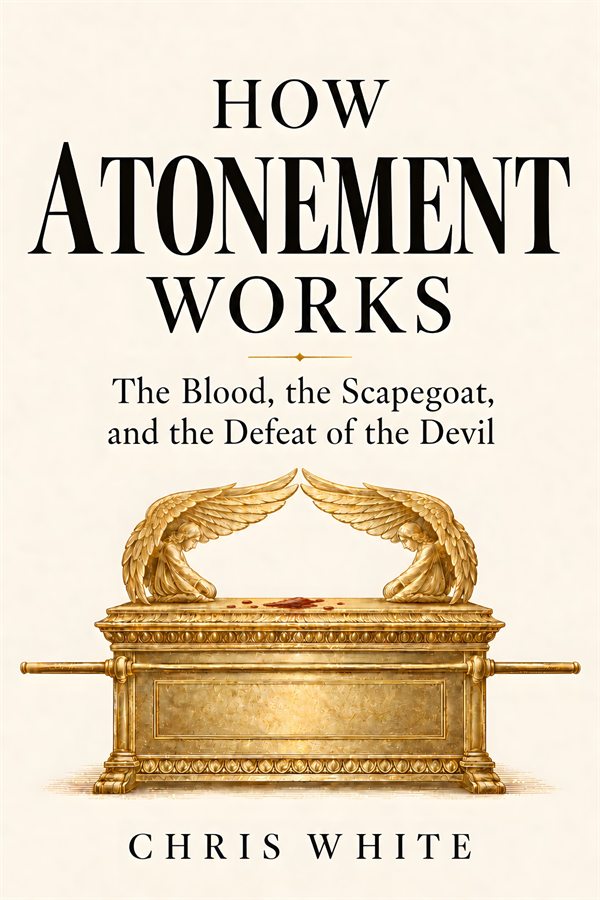
The history on this page comes from chapter 2. How Atonement Works traces how Christians have explained the cross, tests penal substitution against Leviticus and Hebrews, and follows the Day of Atonement through the work of Christ: the blood, the high priest in heaven, the scapegoat, and the defeat of the devil.
Get the Paperback on AmazonWhere the Book’s Account Sits
How Atonement Works starts from the rite the New Testament sets most directly beside Christ’s work, the Day of Atonement. Chris White argues that Christ fulfilled the whole of it. On that day two goats made one atonement (Leviticus 16).
The goat for the LORD: cleansing God’s dwelling
The high priest killed the first goat, carried its blood within the veil, and sprinkled it on the lid of the Ark. With it he made “an atonement for the holy place, because of the uncleanness of the children of Israel” (Leviticus 16:16). Leviticus gives the reason the blood atones: “the life of the flesh is in the blood” (Leviticus 17:11). Following Jacob Milgrom, the book reads these rites as the cleansing of God’s house so that he could keep dwelling among his people. Following David Moffitt, it reads Hebrews as saying that the risen Christ entered heaven by his own blood and presented his life before God. That is why Paul could say that without the resurrection we would still be in our sins, as the article on the resurrection and forgiveness explains more fully.
The goat for Azazel: carrying the sins away
The high priest laid both hands on the second goat, confessed the people’s iniquities over it, and sent it away alive:
And the goat shall bear upon him all their iniquities unto a land not inhabited: and he shall let go the goat in the wilderness.
Leviticus 16:22
The book reads Christ as the sin-bearer who fulfilled this goat as well. He was “once offered to bear the sins of many” (Hebrews 9:28), and he carried them outside the camp and down to the realm of the dead. Chris White proposes that Azazel is Satan and that the sins were sent back to their source, which he calls the return to sender. That identification, and the account of the devil’s power that follows, are the book’s own synthesis, built on readings of Leviticus that many interpreters share and others dispute.
How this explains the victory
The devil tempts people to sin, sin brings death, and he accuses the sinner before God with a charge that is true. When God forgave our sins, “blotting out the handwriting of ordinances that was against us” (Colossians 2:14), the accuser had nothing left to bring against those in Christ, and the powers were disarmed. The book offers this as the mechanism the classic view lacked: Christ “through death” destroyed the devil’s power (Hebrews 2:14), and nothing was paid to the devil.
Where It Agrees and Where It Differs
With the early church. The book keeps the victory over death and the devil, the descent to the dead, the heavenly offering, and the early reading of Christ as the fulfillment of both goats found in the Epistle of Barnabas and Justin Martyr. It parts from the ransom theory on one point: nothing was paid to the devil.
With satisfaction and penal substitution. The book shares a great deal with the teachers of penal substitution. Christ died for us and in our place, our sins were laid on him and he bore them, sin is serious and brings death, God’s wrath against sin is real, and God provided the atonement out of love. The difference lies in how the cross worked. Chris White argues that God forgives freely, as he says through Isaiah: “I, even I, am he that blotteth out thy transgressions for mine own sake” (Isaiah 43:25). He argues that the sacrifices of the law were never punishments, that the sins were placed on the goat that was not killed, that no verse says God’s wrath fell on Jesus, and that the atonement continued in the risen priest’s offering. Chapter 19 sets out eight objections along with the replies of the view’s defenders, among them Leon Morris and Jay Sklar.
With moral influence. The book affirms that the cross shows God’s love (Romans 5:8), and it gives the cross a work beyond its effect on us: cleansing God’s dwelling, carrying sins away, and disarming the accuser.
Richard Barry notes that accounts of the cross tend to emphasize one goat, and he places Anselm’s satisfaction model with the goat for the LORD. The book argues that Christ fulfilled both, so it keeps the cleansing, the sin-bearing and the victory in one account.
These are disagreements among Christians. Teachers of penal substitution, Christus Victor and the other views confess the same crucified and risen Lord.
Where This Understanding Comes From
The history in chapter 2 is drawn from the early writers and later theologians in their own works. The book’s own account builds on Jacob Milgrom’s study of Leviticus and David M. Moffitt’s work on Hebrews, including Rethinking the Atonement (2022). Early Christian writers such as Barnabas, Justin and Tertullian already read the two goats in relation to Christ, and Richard Barry has studied that tradition at length. Samuel Renihan, Barry and Katie Marcar have connected the scapegoat or the Day of Atonement with Christ’s descent and victory. How Atonement Works credits this work and offers its own explanation of how the pieces fit, above all of how Christ defeated the devil’s power of death.