The short answer
The early church held several explanations of Christ’s work together. Irenaeus taught that Christ went over Adam’s ground and defeated the enemy. Many writers said Christ died in our place as a sacrifice and a ransom. Others stressed his victory over death and the devil, his descent to the dead, and his offering in heaven. Barnabas and Justin saw both goats of the Day of Atonement as Christ. No early council defined one theory, and the penal system many Christians know took shape centuries later.
Many Pictures Held Side by Side
The Christians of the first few centuries wrote a great deal about Christ’s death. They took up the New Testament’s own descriptions of it, sacrifice, ransom, redemption, the bearing of sins and victory, and used them side by side. Different writers stressed different ones, and on some details they disagreed sharply. The early ecumenical councils did not define how Christ’s death secured atonement.
How Atonement Works sums up the period in one sentence: “The early church held several ideas together: recapitulation, victory over death and the devil, ransom, sacrifice, substitution, the descent, and Christ’s heavenly ministry.”
The names now used for theories of atonement, such as satisfaction, penal substitution and Christus Victor, came much later. The early writers did not sort themselves into those camps. A plain overview of the later theories is on the page What Are the Different Theories of Atonement?
Irenaeus: Christ Went Over Adam’s Ground
Irenaeus was a bishop in Gaul who wrote around AD 180. He explained Christ’s work as recapitulation, a word that means summing up or going over again. Adam had failed. Christ went over the same ground as a man and succeeded where Adam failed, so that what humanity lost in Adam, the image and likeness of God, could be recovered in Christ. In this summing up, Irenaeus said, God put an end to sin, took away death’s power, and gave life back to humanity.
For Irenaeus this was also a war. Christ fought the enemy who had taken humanity captive in Adam, and he crushed him. Irenaeus also spoke of Christ’s blood as the price of redemption: Christ redeemed us by his own blood, giving his own life and body for ours. In the same passage he said that God won humanity back from the apostasy by persuasion, without force, so that justice was kept and God’s handiwork was not lost. Irenaeus put recapitulation, victory, redemption and the gift of the Spirit together without ranking them.
Behind much early writing is a view of the human problem that Athanasius set out in the fourth century. Humanity was made from nothing and was sliding back toward nothing through sin. The Word took a mortal body so that by his own death he could overcome the death and corruption that sin had brought on the human race. Many early writers saw the devil as the one who held humanity in that condition, and they read the cross through Hebrews:
Forasmuch then as the children are partakers of flesh and blood, he also himself likewise took part of the same; that through death he might destroy him that had the power of death, that is, the devil; And deliver them who through fear of death were all their lifetime subject to bondage.
Hebrews 2:14–15
Christ Died in Our Place
Early Christians said plainly that Christ died for us and in our place. The Epistle to Diognetus, an anonymous letter usually dated to the second century, says that God himself carried the weight of our sins and gave his own Son as a ransom for us, the sinless for sinners. The writer marvels at this exchange: the sins of many covered in one righteous man, and his righteousness given to many.
Justin Martyr, writing in the middle of the second century, took up Paul’s words that “Christ hath redeemed us from the curse of the law, being made a curse for us” (Galatians 3:13). Justin said the Father willed that his Christ take on himself the curses of the whole human family. He also drew a line. The curse the law pronounced on one hanged on a tree fell on Christ, but God did not curse him.
In the fourth century Athanasius wrote that Christ offered himself as a sacrifice for everyone, giving up his body to death in place of all, and so paid the debt that all owed. In Athanasius’s argument that debt is death itself. God had warned that sin would bring death, all people had sinned, and Christ died the death that was owed so that death and corruption could be undone in his own body.
“Penalty” and “punishment” in early writers
Some English translations of early writers use the words “penalty” and “punishment.” Eusebius of Caesarea, explaining Isaiah 53, said that Christ was chastised on our behalf and bore a penalty he did not owe. Augustine said that Christ, though guiltless, took our punishment in order to cancel our guilt.
But he was wounded for our transgressions, he was bruised for our iniquities: the chastisement of our peace was upon him; and with his stripes we are healed.
Isaiah 53:5
The book reads these words in their setting. Eusebius describes what Christ suffered as the scourging, insults, dishonor and death he received for us. Augustine explains that the curse falls on sin, death and human mortality, and that death is the effect of the curse. In both writers the punishment is the suffering and death that came on humanity because of sin. Chris White observes that neither passage describes God pouring out his wrath on Christ, or says that God could not forgive unless someone was punished.
The Ransom and the Fishhook
Jesus said that he came “to give his life a ransom for many” (Mark 10:45). Many early writers asked who received the ransom, and some answered that it was paid to the devil, who held humanity captive.
Gregory of Nyssa, in the late fourth century, developed this answer at length. He reasoned that the devil would never have accepted God openly, so Christ’s divinity was hidden in his human nature, and the devil took the ransom without seeing what it was. Gregory compared it to fishing. The devil swallowed the bait of Christ’s flesh and was caught on the hook of his divinity. So life came into death’s own house, and the darkness was driven out.
Gregory of Nazianzus, a friend from the same circle, disagreed. He asked to whom the blood shed for us was offered. If to the devil, he called it an outrage. He also doubted that the Father had demanded it, since the Father would not even accept Isaac. His conclusion was that the Father accepted the Son’s offering without having asked for it, and that God’s purpose was to rescue us himself, defeat the tyrant, and bring us back to himself through the Son.
The early writers agreed that Christ won the victory and gave different accounts of how his death took away the devil’s power. Chris White calls that gap one of the reasons he wrote the book. On the ransom question he stands with Gregory of Nazianzus. In the book’s account nothing was paid to the devil, and he received nothing he had a right to.
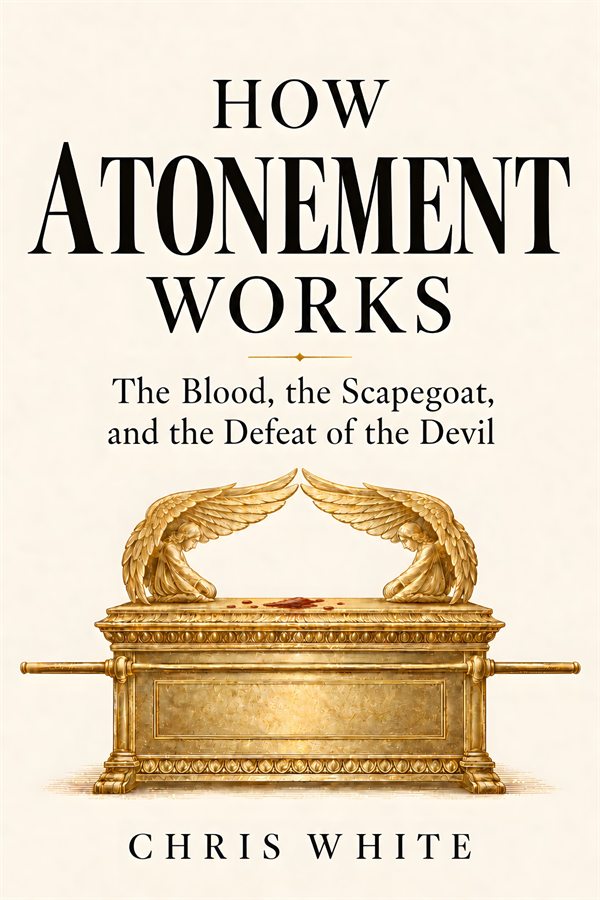
One question runs through the whole history: how did Christ’s death defeat the devil? How Atonement Works traces that victory through the Day of Atonement: the blood, the high priest in heaven, the scapegoat that carried sins away, and Christ’s descent to the dead.
Get the Paperback on AmazonBarnabas and Justin on the Two Goats
On the Day of Atonement in Leviticus 16, Israel’s high priest took two goats. The first was killed as a sin offering, and its blood was carried behind the veil and sprinkled on the lid of the Ark. The second, the live goat, was sent away:
And Aaron shall lay both his hands upon the head of the live goat, and confess over him all the iniquities of the children of Israel, and all their transgressions in all their sins, putting them upon the head of the goat, and shall send him away by the hand of a fit man into the wilderness: And the goat shall bear upon him all their iniquities unto a land not inhabited: and he shall let go the goat in the wilderness.
Leviticus 16:21–22
Hebrews explains Christ’s work by this day. After following the high priest’s blood into the holy place, it says that “Christ was once offered to bear the sins of many” (Hebrews 9:28). Bearing the sins is what the second goat did.
The earliest Christian writers who read the two goats together saw both of them as Christ. The Epistle of Barnabas, written around the end of the first century or the beginning of the second, and Justin Martyr in the middle of the second century both took the slain goat and the sent-away goat as two pictures of the one Lord, and connected them with his two comings.
The book treats these writers as witnesses to how early Christians read the day. What the day means has to be settled from Leviticus and Hebrews. Later Christian traditions tended to build on one goat or the other. Richard Barry, in his study of the two goats, places the satisfaction model of Anselm and Aquinas with the goat for the LORD, and some modern accounts of Christ bearing sin into the depths with the goat for Azazel. How Atonement Works argues that Christ fulfilled both.
The Descent to the Dead
One idea that was common in the early centuries later faded from popular teaching: Christ’s descent to the dead. Ignatius of Antioch, early in the second century, wrote that the prophets had waited for Christ as their teacher, and that when he came he raised them from the dead. Irenaeus wrote that the Lord went down to the regions beneath the earth, and that he announced there that those who believe in him receive forgiveness of sins.
Peter preached the same event on the day of Pentecost, quoting David:
Because thou wilt not leave my soul in hell, neither wilt thou suffer thine Holy One to see corruption.
Acts 2:27
The line “he descended into hell” came into the creed later. It appears in the creed of the church of Aquileia, as Rufinus explained it around the year 400, and Rufinus remarked that the Roman creed and the Eastern churches lacked the words. The belief is older than the clause. Even John Calvin, who read the clause differently, granted that the Fathers all spoke of the descent, though they explained it in different ways.
Origen, in the third century, tied the descent to the Day of Atonement. In a sermon on Leviticus 16 he said that Christ had to go down to hell in order to lead the scapegoat away into that wilderness. In Origen’s reading Christ is the man who leads the goat. Chris White reads Christ as the goat itself, and he proposes that the sins Christ bore were carried down to the realm of the accuser and left there. The book presents that as its own synthesis, building on Leviticus 16, the New Testament texts on the descent, and readers from Origen onward. The fuller case is on the page Did Jesus Descend Into Hell?
Christ’s Offering in Heaven
A second idea that faded from popular teaching is Christ’s offering in heaven. Hebrews says that Christ entered “into heaven itself, now to appear in the presence of God for us” (Hebrews 9:24).
David Moffitt has surveyed early Christian readers of Hebrews, including Hippolytus, Origen, Theodore of Mopsuestia, Theodoret of Cyrus, Narsai and Jacob of Sarug. He found that several of them understood Christ’s atoning offering to include his presentation of himself to the Father in heaven, after the resurrection and ascension. These writers saw the cross as the place where death and the devil were defeated, and they saw the offering continuing into heaven. Gregory of Nazianzus wrote in the same vein that the risen Christ goes on interceding for us in his humanity, since he never laid aside the body he took on.
Later Western theology usually placed the whole atoning work in Christ’s passion and death. The early readers of Hebrews help explain why Paul could say that without the resurrection believers would still be in their sins. That question has its own page on the resurrection and forgiveness.
What Changed Later, and the Main Alternative Reading
A major change in Western thinking came around 1098, when Anselm of Canterbury finished Cur Deus Homo (“Why God Became Man”). He denied that the devil had any rightful claim on humanity and treated the problem as one between humanity and God. Sin, he held, must be answered by satisfaction or by punishment, and Christ’s death was a gift that restored God’s honor. The Reformers kept Anselm’s principle and made the satisfaction the punishment itself: God punished Christ in our place.
Many Christians read the history another way. Defenders of penal substitution, including John Stott, J. I. Packer, and the authors of Pierced for Our Transgressions (2007), argue that it lies at the heart of the biblical teaching, and they have gathered early passages, among them Diognetus, Justin, Eusebius and Augustine, to show that its roots reach back to the early church. They are right that substitution was early and common. The book’s reply is that the punishment language in those passages refers to the death and curse that sin brought on humanity, and that the full system, with Christ bearing God’s wrath and the principle that God cannot forgive without satisfaction or punishment, took its present form from Anselm to the Reformation.
From the other side, Gustaf Aulén argued in Christus Victor (1930) that the “classic” view of Christ’s victory over the powers was the main view of the early church. The book agrees that victory held a central place, and notes that the same writers spoke just as freely of sacrifice and substitution.
Age alone does not settle the question. A late doctrine can be true, and an early one can be mistaken, so the question has to be settled from Scripture. The history does show that the explanation many Christians hold today is one of several that faithful Christians have held.
Where This Understanding Comes From
The early material on this page comes from the writers’ own works as the book cites them, among them Irenaeus’s Against Heresies, Justin Martyr’s Dialogue with Trypho, Athanasius’s On the Incarnation and Origen’s Homilies on Leviticus. David M. Moffitt’s Rethinking the Atonement (2022) supplied the survey of early readers of Hebrews. Richard J. Barry’s Jewish Temple Theology and the Mystery of the Cross (2024) and Andrei Orlov’s The Atoning Dyad trace the two-goat readings. Samuel Renihan’s Crux, Mors, Inferi gathers the history of the descent, and Gustaf Aulén’s Christus Victor named the classic view. How Atonement Works builds on this scholarship and credits it. Its account of the two goats and the defeat of the devil is a synthesis of old themes, offered as one Christian reading among others.