The short answer
Christians disagree. Penal substitution, the view most often preached, answers yes: God’s justice required sin to be punished, and Jesus willingly bore that punishment in our place, though the Father was never angry with his Son. Chris White’s book agrees that Christ died for us, in our place, and bore our sins. It argues that Scripture describes this as sin-bearing and cleansing rather than punishment. In Leviticus the goat that carried the sins was not killed, and no verse says God’s wrath fell on Jesus.
Why Christians Ask This Question
Jesus died a criminal’s death, and the prophets and apostles say he died for our sins. Isaiah wrote of the servant of the LORD: “he was wounded for our transgressions, he was bruised for our iniquities: the chastisement of our peace was upon him; and with his stripes we are healed” (Isaiah 53:5). From the cross Jesus cried, “My God, my God, why hast thou forsaken me?” (Matthew 27:46).
Many sermons put these passages together and say that God poured out his wrath on Jesus in our place. Some hearers find that the clearest picture of God’s love they have ever heard. Others are troubled by it and ask whether the Father really punished his own Son. Both groups are Christians, and both want the answer that Scripture gives.
The Answer Most Often Preached: Penal Substitution
The explanation of the cross most often preached today says that God’s justice requires sin to be punished. Jesus took that punishment in our place. God’s wrath against our sin was poured out on him and satisfied there, and because of that God forgives those who believe. Its teachers call it penal substitutionary atonement: “penal” because a penalty was paid, and “substitutionary” because Jesus paid it instead of us.
The view has deep roots in Protestant teaching. The Heidelberg Catechism says that Christ bore the wrath of God against the sin of the whole human race in body and soul, throughout his life and especially at its end. The Westminster Confession says that Christ fully satisfied his Father’s justice. Wayne Grudem’s widely used Systematic Theology defines Christ’s death as penal because he bore a penalty, and substitutionary because he bore it in our place.
Its defenders point to several passages. Isaiah says that “the LORD hath laid on him the iniquity of us all” (Isaiah 53:6). Paul says that Christ redeemed us from the curse of the law, “being made a curse for us” (Galatians 3:13), and that God “made him to be sin for us, who knew no sin” (2 Corinthians 5:21). In Romans 3:25 Paul says that God set Christ forth “to be a propitiation through faith in his blood.” Leon Morris argued that the Greek words in this family were used in ordinary speech for turning away anger, that Paul has just described God’s wrath against all sin (Romans 1:18–3:20), and that the cross shows God to be both just and the one who justifies believers (Romans 3:26).
Careful teachers of the view also draw distinctions that popular summaries leave out. John Calvin taught that Christ bore the punishment we deserved, yet he denied that the Father was ever hostile to his Son or angry with him. Christ bore God’s anger against our sins, while remaining the beloved Son in whom the Father was well pleased. Calvin also held, with Augustine, that God’s love comes before the cross and is not produced by it. Defenders insist that the Son was not an unwilling victim. Garry Williams argues that the Father and the Son act together in the atonement and that the Son willed what was done and offered himself. John Stott called the cross the self-substitution of God. On their account, God in Christ bore his own judgment out of love.
How Atonement Works shares a great deal with this view. It holds that Christ died for us and in our place, that our sins were laid on him and he bore them, and that sin is serious enough that it cost the Son of God his life. God’s wrath against sin is real, and those who are in Christ will be saved from it. The cross was necessary, and Christ’s sacrifice was offered once for all. In the book’s words, “I differ from the view over how the cross worked.” A broader survey of the debate is on the page Is Penal Substitution Biblical?
Were the Sacrifices in Leviticus Punishments?
Penal substitution reads the Old Testament sacrifices as pictures of an animal punished in the worshiper’s place. The book argues that Leviticus describes them differently. The animal had to be without blemish (Leviticus 1:3; 4:3), and the law gives no instruction to make it suffer. It was killed, and the law then turns to what the priest did with its blood at the altar. The priests’ service kept wrath from breaking out against the people (Numbers 18:5), but no passage says that God’s wrath fell on the animals offered.
Atonement was also made for things that cannot be punished, such as the altar and the holy place (Leviticus 16:16–20), and for a woman after childbirth who had no sin to confess (Leviticus 12:7–8). The law’s word for what the rite did is “cleanse,” and Leviticus states the purpose of the Day of Atonement in the same word:
For on that day shall the priest make an atonement for you, to cleanse you, that ye may be clean from all your sins before the LORD.
Leviticus 16:30
Some defenders of the penal view answer, following the Leviticus scholar Jay Sklar, that the animal’s life was a ransom: a lesser payment that God was free to accept in place of the worshiper’s life. The book replies that even on that reading God’s wrath does not fall on the animal, and the outcome rests on God’s free choice to accept a gift he himself provided.
The Goat That Bore the Sins Was Not Killed
Penal substitution pictures sin placed on a victim who is then killed for it. On the Day of Atonement those two acts happen to two different animals. The goat for the LORD was killed, and its blood was carried behind the veil to cleanse the sanctuary. No sins were confessed over it. Aaron laid both hands on the second goat, confessed over it “all the iniquities of the children of Israel,” and sent it away alive:
And the goat shall bear upon him all their iniquities unto a land not inhabited: and he shall let go the goat in the wilderness.
Leviticus 16:22
This is the only rite in the law in which sins are said to be placed on an animal. The book argues that when the New Testament speaks of Christ bearing our sins, it draws on this picture. Isaiah says that “the LORD hath laid on him the iniquity of us all” (Isaiah 53:6) and that the servant “shall bear their iniquities” (53:11), the language Leviticus 16 used of the live goat. Peter writes that Christ “his own self bare our sins in his own body on the tree” (1 Peter 2:24). Chris White reads Paul’s words “made him to be sin for us” (2 Corinthians 5:21) in the same light: our sins were really laid on Christ, and he carried them, as the goat carried Israel’s.
Defenders reply that the two goats were one sin offering (Leviticus 16:5). The book agrees that the rite was not complete without both. It adds that the unity of the rite does not place the people’s sins, or their punishment, on the goat that was killed, because the text puts the sins on the other goat.
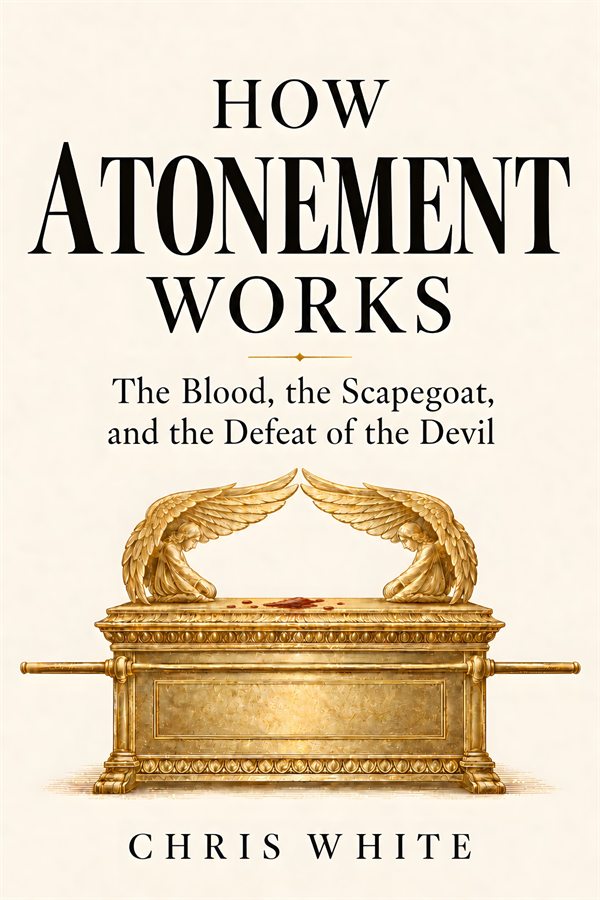
Both sides, with their sources. How Atonement Works states penal substitution in the words of its own teachers, sets out eight objections, and gives the defenders’ replies to each.
Get the Paperback on AmazonDid God’s Wrath Fall on Jesus?
God’s wrath is real, and the New Testament speaks of it often. It most often speaks of it as still to come: “the wrath to come” (1 Thessalonians 1:10), “the day of wrath” (Romans 2:5), the wrath of the Lamb at the end of the age (Revelation 6:16–17). Paul says that believers will be saved from it:
Much more then, being now justified by his blood, we shall be saved from wrath through him. For if, when we were enemies, we were reconciled to God by the death of his Son, much more, being reconciled, we shall be saved by his life.
Romans 5:9–10
The book asks why Paul would place our rescue from wrath in the future, and tie it to Christ’s life as well as his death, if that wrath had already been spent on Jesus at the cross. No verse in the New Testament says that the wrath of God was poured out on Jesus, or that his sufferings satisfied God’s anger. For a subject the apostles mention so often, Chris White would expect at least one of them to say so if it had happened.
Defenders answer that the teaching is present in passages that do not use those words, Romans 3:25 above all. The book reads that verse differently. Paul’s Greek word for “propitiation” is the word the Greek Old Testament uses for the lid of the Ark, the mercy seat, where the high priest sprinkled the blood on the Day of Atonement. Hebrews uses it for the same object (Hebrews 9:5). On this reading God set Christ forth as the place where atonement is made through his blood. In the Old Testament accounts where atonement stops God’s wrath, no one receives the wrath in the people’s place. When the plague had begun, Aaron “made an atonement for the people” with incense, “and the plague was stayed” (Numbers 16:46–48).
“Why Hast Thou Forsaken Me?”
Many Christians hear Jesus’ cry from the cross as the moment the Father turned away from him. Calvin wrote that Christ experienced the signs of an angry and avenging God, while denying that the Father was angry with him. William Bucanus, a Reformed teacher of the next generation, said that God was never angry with his Son and never forsook him, but hid his favor for a time, so that Christ’s human nature truly felt that distress.
Jesus was quoting the first line of Psalm 22, and the psalm goes on to say that God did not hide his face from the sufferer and heard him when he cried (Psalm 22:24). The night before, Jesus had told his disciples that they would leave him alone, yet he was not alone, because the Father was with him (John 16:32). The book takes the cry as the prayer of the righteous sufferer of Psalm 22, spoken in real anguish, by a Son the Father had not cast off.
Calvin’s distinction leaves a question. If the Father was not angry with the Son, and yet the Son bore God’s anger against our sins, then that anger fell on a person, and the person was the eternal Son. The church confessed at Chalcedon that Christ is one person in two natures. Defenders answer that the Son willed what was done to him and that God in Christ bore his own judgment. Following Drew Whitton, the book replies that a willing subject of condemnation is still condemned, so the question of who was condemned remains.
Must God Punish Sin Before He Can Forgive?
Penal substitution rests on a principle Anselm of Canterbury stated in the eleventh century and the Reformers kept: it is not right for God to cancel sin without compensation or punishment. The book argues that Scripture shows God forgiving freely many times. He spared Nineveh when its people turned from their evil way (Jonah 3:10). He described himself to Israel this way:
I, even I, am he that blotteth out thy transgressions for mine own sake, and will not remember thy sins.
Isaiah 43:25
Jesus forgave the paralytic and the woman in Simon’s house (Mark 2:5; Luke 7:48). In his parable the king, “moved with compassion,” forgave the servant’s debt without collecting it from anyone (Matthew 18:27), and Paul tells believers to forgive “even as God for Christ’s sake hath forgiven you” (Ephesians 4:32). Defenders answer that God forgave in view of the cross to come (Romans 3:25), and that forgiveness is free to us because God paid the price himself in his Son. The book agrees that forgiveness cost God his Son. It points out that Scripture’s words for what God does with sin are forgive, pardon, blot out, and remove.
The law also forbids punishing the innocent for another’s guilt. “He that condemneth the just” is “abomination to the LORD” (Proverbs 17:15), and “every man shall be put to death for his own sin” (Deuteronomy 24:16). The usual reply is that Christ consented and that his union with his people makes the transfer just. Leon Morris added that God’s nature is merciful as well as just. The book takes Morris’s point the other way: if God’s nature is merciful as well as just, his justice does not require him to punish an innocent man before he forgives. It also notes that what Christ suffered ended on the third day, while Scripture describes the penalty for the unrepentant as final.
What the Book Says Happened at the Cross
Chris White proposes that the cross worked by sin-bearing, by the giving of Christ’s life, and by cleansing, all of which belong to the Day of Atonement. This is his reading, and many faithful Christians hold the penal view instead.
On the cross Christ bore our sins, as the live goat bore Israel’s, and carried them away from us. He also gave his life. Leviticus explains why blood atones:
For the life of the flesh is in the blood: and I have given it to you upon the altar to make an atonement for your souls: for it is the blood that maketh an atonement for the soul.
Leviticus 17:11
The risen Christ then entered heaven “by his own blood” (Hebrews 9:12) as our high priest, to appear in the presence of God for us. That is why Paul could say that without the resurrection we would still be in our sins, a subject covered on the page Why Does the Resurrection Matter for Forgiveness? God forgives freely because he delights in mercy (Micah 7:18), and the cross is the means by which he forgave. His wrath remains real, and those who are in Christ “shall be saved from wrath through him.”
So the book’s answer to the question is no: God did not punish Jesus. The Father gave his Son, the Son gave himself, and he bore the sins of the world in love. Christians on both sides of this disagreement confess together that “Christ died for our sins according to the scriptures” (1 Corinthians 15:3).
Where This Understanding Comes From
The book engages the strongest defenders of penal substitution, including John Calvin, Leon Morris, Jay Sklar, Anthony Petterson, and Garry Williams, and states their replies alongside its objections. On the other side it draws on David M. Moffitt’s Rethinking the Atonement (2022), which argues that suffering inflicted on the victim was no part of the biblical sacrifices and that Christ’s offering was presented in heaven. William Milligan argued in 1892 that death alone cannot explain the offering. Richard Barry’s study of the two goats shows that Barnabas, Justin Martyr, and Tertullian distinguished the two animals and placed the curse on the goat sent away. Drew Whitton’s recent work examines penal substitution in light of the Definition of Chalcedon. How Atonement Works builds on this scholarship and credits it.