The short answer
The harrowing of hell, or of Hades, is the old name for what Christ did among the dead between his death and his resurrection. He entered the realm of the dead as a conqueror and brought captives out. Christians draw it from Ephesians 4:8–10, 1 Peter 3:18–19, and Matthew 27:52–53, and Eastern icons of Easter still picture it. Chris White argues that the captives went free because Christ had carried away the sins that gave the accuser his claim on them.
What the Harrowing of Hell Means
“Harrowing” comes from an Old English word for raiding or plundering, related to the modern word “harry.” Medieval English preachers and poets used it for Christ breaking into the realm of the dead and bringing out those who were held there. The mystery plays of York and Chester staged the harrowing of hell as a scene of its own.
The “hell” in the phrase is Hades, the place where the dead went, which the Old Testament calls Sheol. It is a different place from the lake of fire. Revelation keeps the two apart: at the last judgment “death and hell delivered up the dead which were in them,” and then “death and hell were cast into the lake of fire” (Revelation 20:13–14). For that reason many writers prefer to speak of the harrowing of Hades. The difference between Hades and hell, and the creed’s line “he descended into hell,” are explained in Did Jesus Descend into Hell?
The Eastern churches have kept this teaching at the center of Easter. The Orthodox icon of the resurrection, called the Anastasis, shows the descent itself. Christ stands on the broken gates of Hades, with bolts and keys scattered in the dark beneath him, and pulls Adam and Eve up out of their tombs by the wrist while kings and prophets of the Old Testament wait behind them. The Orthodox Easter hymn sings of Christ trampling down death by death. In the West the same belief stands behind the Apostles’ Creed and the quiet of Holy Saturday.
The Bible Passages Behind It
The word “harrowing” belongs to later English. The teaching gathers several passages that describe Christ among the dead. The plainest is in Ephesians, where Paul quotes Psalm 68, a psalm about God going up to his holy place with captives in his train:
Wherefore he saith, When he ascended up on high, he led captivity captive, and gave gifts unto men. (Now that he ascended, what is it but that he also descended first into the lower parts of the earth? He that descended is the same also that ascended up far above all heavens, that he might fill all things.)
Ephesians 4:8–10
The one who ascended “far above all heavens” had first gone down as far as there is to go. Early Christian readers took the captives in his procession either as the enemies he defeated or as the prisoners he set free.
Peter’s first letter places a proclamation among the dead between Christ’s death and his enthronement:
For Christ also hath once suffered for sins, the just for the unjust, that he might bring us to God, being put to death in the flesh, but quickened by the Spirit: By which also he went and preached unto the spirits in prison.
1 Peter 3:18–19
A chapter later Peter speaks of “the gospel preached also to them that are dead” (1 Peter 4:6). Matthew records what happened when Jesus died:
And the graves were opened; and many bodies of the saints which slept arose, And came out of the graves after his resurrection, and went into the holy city, and appeared unto many.
Matthew 27:52–53
Other passages fill out the picture. At Pentecost Peter applied Psalm 16 to Christ: “thou wilt not leave my soul in hell, neither wilt thou suffer thine Holy One to see corruption” (Acts 2:27). The risen Christ told John that he has “the keys of hell and of death” (Revelation 1:18), and a key is authority over a place, the power to open it and to shut it. The prophets had already promised a release from the dead. Hosea has God say, “I will ransom them from the power of the grave; I will redeem them from death” (Hosea 13:14).
How the Early Church Told It
The belief is older than the creed’s clause. In the second century Ignatius wrote that Christ raised the prophets who had waited for him, and Irenaeus wrote that the Lord went down to the regions beneath the earth, announcing his coming there and declaring the forgiveness of sins to those who believed in him. In the third century Origen connected Christ’s descent with the live goat of the Day of Atonement. Eusebius described Christ driving death before him until he burst the gates of its dark realm and opened a road back to life for the dead. Gregory of Nazianzus wrote that Christ went down into Hades and led souls up with him.
Later centuries filled in the story. An apocryphal work known as the Gospel of Nicodemus told it at length, with Christ breaking the gates and leading Adam and the prophets out, and medieval sermons, paintings, and plays drew on it. Those details go beyond the Bible. The core of the teaching, a victorious Christ among the dead, comes from the passages above.
Where Christians Disagree
Christians who confess the descent have understood it in several ways.
- Calvin and the Heidelberg Catechism. John Calvin called the idea of an underground prison of the fathers a fable. He read “he descended into hell” as the anguish Christ suffered in his soul on the cross and in Gethsemane, when he bore the weight of God’s judgment against sin. The Heidelberg Catechism teaches the same, and many Reformed churches follow it.
- Ephesians 4:9. Some readers take “the lower parts of the earth” to mean the earth itself, so that the descent is the incarnation. The Geneva Bible’s note read it that way, and the Westminster annotators took it as Mary’s womb.
- 1 Peter 3:19. Augustine suggested that Christ preached through Noah to the people of Noah’s day, who were dead by the time Peter wrote. Many interpreters today take the spirits in prison as the angels who sinned in Noah’s time, to whom Christ proclaimed his victory.
- Who came out. The Catholic Church teaches that Christ went down to free the just who had gone before him, and that he did not go to deliver the damned or to abolish the place of punishment.
How Atonement Works follows the early church in reading the texts as a real descent of Christ’s soul to the dead between Friday and Sunday. In each passage that places him among the dead, he acts or God vindicates him: death could not hold him, his soul was not left in Hades, he made a proclamation, and he came out holding the keys. The book puts it in one sentence: “In the descent, as Scripture describes it, Christ is a victor in the enemy’s own territory.”
Calvin wanted nothing taken away from the cross, and the book shares that concern. It places Christ’s suffering on the cross, where he said “It is finished,” and it reads the descent as what Christ did next, having borne our sins.
The Book’s Account: Why the Captives Went Free
Early Christian writers agreed that Christ won this victory, and they explained it in different ways. Chris White offers an explanation of how it worked. He presents it as his own synthesis of the texts, and it begins with a verse in Hebrews:
Forasmuch then as the children are partakers of flesh and blood, he also himself likewise took part of the same; that through death he might destroy him that had the power of death, that is, the devil; And deliver them who through fear of death were all their lifetime subject to bondage.
Hebrews 2:14–15
The book argues that the devil’s power of death rested on sin. He tempts people and then accuses them before God, and his accusation has force because the sin is real. Paul writes that “the sting of death is sin” (1 Corinthians 15:56).
On the Day of Atonement the live goat carried Israel’s confessed sins out of the camp to “a land not inhabited” (Leviticus 16:22). The book reads Christ’s descent as the fulfillment of that journey. Having borne our sins on the cross, he carried them down to the dead, and God forgave them. Paul says that God, “having forgiven you all trespasses,” blotted out “the handwriting of ordinances that was against us” and “spoiled principalities and powers” (Colossians 2:13–15). With the sins carried away and forgiven, the accuser had nothing left to charge. The book sets out this part of the argument more fully in How Did Jesus Defeat the Devil by Dying?
The dead of the old covenant faced the same accuser and the same charge as the living. What cancelled the charge for the living cancelled it for them. So the book sees the harrowing as the first effect of the devil’s defeat: the people he had held were brought out. Irenaeus joined the descent to the forgiveness of sins without explaining why the two belong together. On Chris White’s account they belong together because the one who went down among the dead had just carried away the sins that held them there.
Hebrews says what the release was for. Christ’s death was “for the redemption of the transgressions that were under the first testament” (Hebrews 9:15), the sins of the people of the old covenant. Of the heroes of faith in its eleventh chapter, Hebrews says that they “received not the promise: God having provided some better thing for us, that they without us should not be made perfect” (Hebrews 11:39–40). They died waiting, and their perfecting waited on Christ.
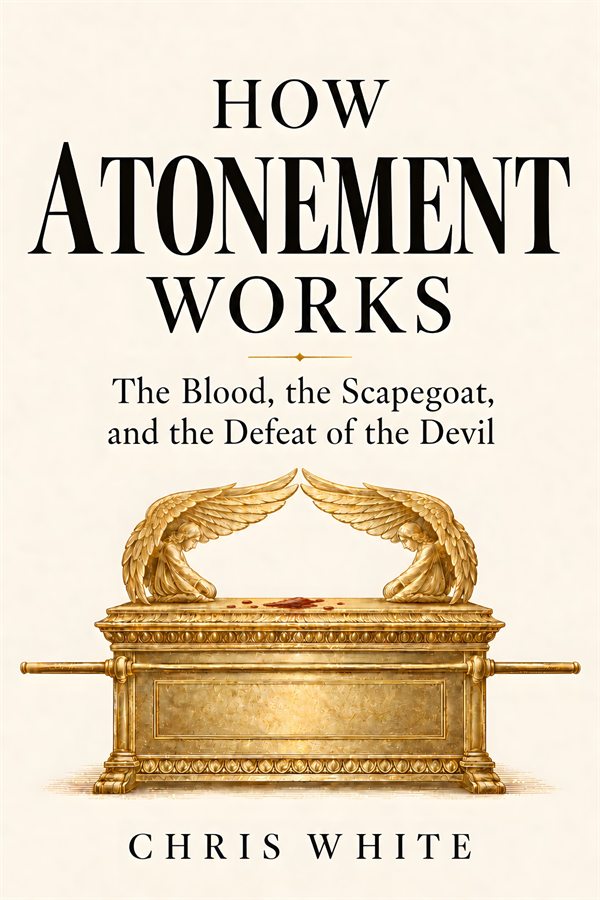
The harrowing is one part of a larger account. How Atonement Works traces the whole Day of Atonement through the work of Christ: the blood, the high priest in heaven, the scapegoat that carried sins away, and the defeat of the devil.
Get the Paperback on AmazonThe Year of Release, Proclaimed on the Day of Atonement
Every fiftieth year Israel kept a Jubilee. Land sold in hard times went back to its family, and Israelites who had sold themselves into service went free. Leviticus sets the start of that year on one particular day:
Then shalt thou cause the trumpet of the jubile to sound on the tenth day of the seventh month, in the day of atonement shall ye make the trumpet sound throughout all your land. And ye shall hallow the fiftieth year, and proclaim liberty throughout all the land unto all the inhabitants thereof.
Leviticus 25:9–10
The Greek translators of the Old Testament called the Jubilee “the year of release,” using the word aphesis. The New Testament uses the same word for the forgiveness of sins, and the Greek Old Testament used it for the goat sent away on the Day of Atonement. Isaiah took the Jubilee’s language for the Servant’s work, “to proclaim liberty to the captives, and the opening of the prison to them that are bound” (Isaiah 61:1). Jesus read that passage at Nazareth and said, “This day is this scripture fulfilled in your ears” (Luke 4:21).
The Jubilee also shows a release in which the holder is paid nothing. An Israelite in service could be redeemed by a kinsman who paid the price. If no one paid, “he shall go out in the year of jubile, both he, and his children with him” (Leviticus 25:54). His master’s claim ended because God had declared the year. The book takes the trumpet’s placement on the Day of Atonement as deliberate, and it reads the devil’s defeat the same way: his claim on the captives ended by God’s decree, and he received nothing for them.
A Jewish reader had connected these ideas about a century before Christ. A fragmentary Dead Sea Scrolls commentary known as 11QMelchizedek reads the Jubilee laws with Isaiah 61 as a prophecy of the last days, in which captives held under Belial, the scroll’s name for the adversary, are set free, their sins are forgiven, and the release falls on a Day of Atonement.
Who Was Set Free?
The scope of the release is one of the disputed questions. How Atonement Works centers it on the faithful of the old covenant, the people Hebrews 11 describes, who died in faith and whose perfecting waited on Christ. The book ties the release to forgiveness, and so it gives no ground for saying that everyone in Hades was saved or that everyone who had died was given a second chance.
Jesus told the thief on the cross, “To day shalt thou be with me in paradise” (Luke 23:43), and in his story of the rich man and Lazarus the poor man was comforted in “Abraham’s bosom” (Luke 16:22). Chris White understands paradise before the resurrection as a place of comfort among the dead, and he understands the righteous as brought from there into the presence of the Lord, where Paul expected to be when absent from the body. He offers a best guess about why comfort among the dead was not enough: it was still the realm of the dead and the territory of the one who had the power of death, short of the communion with God that atonement was for.
What the Harrowing Means for Christians Today
Hebrews names the purpose of Christ’s victory: to “deliver them who through fear of death were all their lifetime subject to bondage” (Hebrews 2:15). The realm of the dead has been entered by the Son of God, its captives have been brought out, and its keys are in his hand. A Christian who dies goes, in Paul’s words, “to be present with the Lord” (2 Corinthians 5:8), and that Lord holds the keys.
The book explains the defeat of the devil as the end of his claim over those whose sins have been taken away. Christians still face temptation, and their bodies still die. Their sins are forgiven in Christ, the accuser has no charge to bring against them, and they wait for the day when “they that are Christ’s” will be raised at his coming (1 Corinthians 15:23).
Where This Understanding Comes From
The descent of Christ and the release of the dead were taught widely in the early church, by Ignatius, Irenaeus, Origen, Eusebius, Gregory of Nazianzus, and others. Samuel Renihan’s primer and reader on the descent, Crux, Mors, Inferi, defends the descent as a victory and connects it with the scapegoat, and Richard Barry’s study of the two goats of Yom Kippur traces that connection back to Origen. Katie Marcar’s 2025 article in New Testament Studies argues that Hebrews knows the descent and the harrowing of Hades, building on David Moffitt’s work on Passover and the exodus in Hebrews 2. The book also draws on Richard Bauckham and Daniel Stökl Ben Ezra for the Jewish background. How Atonement Works credits this scholarship and adds an explanation of how forgiveness ended the accuser’s claim on the dead.